We began this class talking about Francis Bacon, the father of induction in science. Bacon began with particular observations of nature and derived generalizations. We saw this as a huge break from the syllogisms of the scientific method in the past, mostly through Aristotle. Cohen, however, attributes a new "scientific method" to Newton that once again breaks with tradition:
"We may note that Newton has treated Kepler's laws exactly in the same order as Kepler himself: first the law of areas as a general theorum, and only later the particular shape of planetary orbits as ellipses. What seemed at first to be a rather odd way of proceeding has been shown to represent a fundamental logical progression of a kind that is the opposite of the sequence that would have been followed in an empirical or observational approach" (163).
Cohen also makes many mentions of Newton's particular genius in leaping from theses to conclusions. Could we attribute Newton's genius more to the development of this new scientific method (the explanation of the universe by mechanical/mathematical principles) than to his natural reasoning skills about the universe? What helped Newton make this jump when so many of his predecessors came so close but failed to make the breakthrough (ex. Kepler, Galileo, Hooke, Halley)?
Thursday, November 13, 2008

Tuesday, November 11, 2008
The Advancement of Knowledge!
Newton's thinking on physics and calculus revolutionized the fields of mathematics and science. In light of this, I thought our class might appreciate Saul Bass' animated rendering of man's striving for knowledge (very Pesic).
About two minutes in, Bass comments on the heliocentric v. geocentric debate. Super funny in my opinion.
http://www.youtube.com/watch?v=leG6mHng48
Saturday, November 8, 2008
Newton and Particle Accelerators
This is an interesting article from National Geographic on one of the world's largest particle accelerators which is located in France. At the end of the article a physicist says, "Every day I go to work I'm making a bet that the universe is simple, symmetric, and aesthetically pleasing—a universe that we humans, with our limited perspective, will someday understand." Newton and Galileo laid the foundations for a scientific understand of a universe that behaves systematically, but new discoveries about the fundamentals of matter have made some scientists question whether the universe is fundamentally ordered, or "aesthetically pleasing." Should discoveries about the fundamental particles of matter affect our decision-making? Or are these discoveries and their implications on the order of the universe irrelevant for most of us? How would Newton respond to these questions?
Friday, November 7, 2008
For the Baconians out there
Those of you planning to write on the New Atlantis may find this interesting. Attached to the original manuscript of Bacon's work (and published with it in its first edition) was a list of "Magnalia naturae, praecipue quoad usus humanos" -- great works of nature especially intended for human utility. Their relation to the utopia is not specified, but presumably they have something to do with the sciences that would be necessary in Bensalem. Inexplicably, the editor of our edition omits them (I meant to circulate them at the time, but forgot -- apologies) so here they are:
The prolongation of life.
The restitution of youth in some degree.
The retardation of age.
The curing of diseases counted incurable.
The mitigation of pain.
More easy and less loathsome purgings.
The increasing of strength and activity.
The increasing of ability to suffer torture or pain.
The altering of complexions, and fatness and leanness.
The altering of statures.
The altering of features.
The increasing and exalting of the intellectual parts.
Versions of bodies into other bodies.
Making of new species.
Transplanting of one species into another.
Instruments of destruction, as of war and poison.
Exhilaration of the spirits, and putting them in good disposition.
Force of the imagination, either upon another body, or upon the body itself.
Acceleration of time in maturations.
Acceleration of time in clarifications.
Acceleration of putrefaction.
Acceleration of decoction.
Acceleration of germination.
Making rich composts for the earth.
Impressions of the air, and raising of tempests.
Great alteration; as in induration, emollition, &c.
Turning crude and watery substances into oily and unctuous substances.
Drawing of new foods out of substances not now in use.
Making new threads for apparel; and new stuffs; such as paper,glass, &c.
Natural divinations.
Deceptions of the senses.
Greater pleasures of the senses.
Artificial minerals and cements.
(For those of you who are suspicious about Bacon's methods for achieving the New Atlantis, a couple of these sciences may give you a lot to think about.)
The prolongation of life.
The restitution of youth in some degree.
The retardation of age.
The curing of diseases counted incurable.
The mitigation of pain.
More easy and less loathsome purgings.
The increasing of strength and activity.
The increasing of ability to suffer torture or pain.
The altering of complexions, and fatness and leanness.
The altering of statures.
The altering of features.
The increasing and exalting of the intellectual parts.
Versions of bodies into other bodies.
Making of new species.
Transplanting of one species into another.
Instruments of destruction, as of war and poison.
Exhilaration of the spirits, and putting them in good disposition.
Force of the imagination, either upon another body, or upon the body itself.
Acceleration of time in maturations.
Acceleration of time in clarifications.
Acceleration of putrefaction.
Acceleration of decoction.
Acceleration of germination.
Making rich composts for the earth.
Impressions of the air, and raising of tempests.
Great alteration; as in induration, emollition, &c.
Turning crude and watery substances into oily and unctuous substances.
Drawing of new foods out of substances not now in use.
Making new threads for apparel; and new stuffs; such as paper,glass, &c.
Natural divinations.
Deceptions of the senses.
Greater pleasures of the senses.
Artificial minerals and cements.
(For those of you who are suspicious about Bacon's methods for achieving the New Atlantis, a couple of these sciences may give you a lot to think about.)
Wednesday, November 5, 2008
What's he actually proving?
What is Newton actually proving in 1.1? The commentary says that "what this proposition tells us is that if there are such forces operating, the result will be equable description of areas" (p 46). Firstly, what exactly does that mean? If we aren't proving that centripetal force exists, what are we actually proving about centripetal forces?
One other thought...I think that Newton's lack of attention to causes is striking. The commentary says "But Newton has not given us a force at the center, only a center towards which the forces are directed" (41). Everything else we've been reading this semester has had some sort of stress on causes, but Newton deliberately avoids cause at all costs.
One other thought...I think that Newton's lack of attention to causes is striking. The commentary says "But Newton has not given us a force at the center, only a center towards which the forces are directed" (41). Everything else we've been reading this semester has had some sort of stress on causes, but Newton deliberately avoids cause at all costs.
Reading the Proofs
In Section 2, we are constantly reminded by the Arial font that we cannot read these proofs from a modern perspective with their ultimate implications in mind. This is difficult to do. It is like reading a mystery novel when you already know the ending; it is very easy to see the clues and very difficult to appreciate the puzzle.
Tuesday, November 4, 2008
Newton and Heliocentrism
Even though Newton's Principia was published over fifty years after Galileo's trial, I find it interesting that he apparently received little to no censure from the Church (although he does say that God organized the world according to the physics he articulates). My question then is more factual than theoretical, as I simply wonder what the final straw was that broke the Church's back and convinced it to stop condemning and punishing those who accepted heliocentrism. Did Newton publish his ideas in a world that had already accepted heliocentrism, or was it his demonstrations that finally led to the Church and the laity in general to change their stance on how the universe was organized?
Newton <3's Euclid
I don't think I quite understood the extent of Newton's geometrical proofs until I attempted the 2nd reading today. What a throwback to Euclid's elements in Nat. Sci.! I think it's very interesting that Newton chose to use geometry to explain physics even though he had calculus at his disposal. What advantage does geometry have over calculus that Newton chose to represent his ideas in this way?
Newton and Religion
After reading the Galileo trial, I cant help but think about how Newton's theories affected religion. Specifically, I think that the way that he is able to describe the world around him using calculus says something very definite about the order of the universe. But what is striking is not just that he does this, but that his explanations seem to leave room for God working in the world. He describes at length centripetal force, but he does not define a center of the force, or what is causing the force. We don't know yet how these forces are created. Is it the impetus of God? Or does this calculated description of the world leave no room for divine action in it?
Monday, November 3, 2008
Euclid Again?!
First of I just wanted to comment on how much some of this second reading resembled Euclid...yikes. That out of the way, I am awed by Galileo's deduction of the three laws of motion. For the past couple hundred years it seemed that laws regarding physics, mathematics, and astronomy were quickly replaced by more accurate theories, with of course some exceptions. Galileo's three laws of motion, however, remain very important in the physics of today. They are one of the first things that people think of when physics is mentioned, as well as one of the first laws to be taught. There is, I believe, at similarity in the authority of the teachings of Aristotle and Galileo in that they transcended the science of their times by many centuries, and remained the authorities, in at least some respects, in various scientific fields.
Inertia
I am struggling to understand the difference between Galileo's understanding of inertia and Newton's understanding of it. Can we please go over the two conceptions of inertia in contrast to each other? I think that when Newton uses the term, he is talking about the idea that bodies in motion tend to stay in motion, but I'm not sure how that differs from what Galileo mean by inertia.
Space and Timie question
I was just wondering why Newton felt compelled to establish space and time, before he proceeded with his laws of physics. He goes to an thorough job of defining place and relative vs absolute motion and such. And I was wondering why it is necessary to know this? (I understand that this question can be asked for a lot, and I am not just asking a rhetorical answer but and interested how this plays a role in his physics.) Does this have anything to do with proceeding in his Principia in a geometrical proof-esque way?
Sunday, November 2, 2008
Definitions, but not assertions?
I am confused by what is exactly meant by the idea of these just being definitions and not proofs. Densmore says “We must again remember that this is a definition of how the term will be used. It is not a proof or even an assertion that this thing exists” (16). How do you make these statements about mass, force, or centripetal force without asserting that a thing exists? Is not that the whole point of the work? If this is like Euclid, then what follows these definitions has to something that follows directly from them. This does work if we are not trying to say something about the real world, but once we are trying to say something about the real world, then do you not have to be making assertions about whether or not something exists. Being that we have only read this very preliminary part, the answer to this is probably unclear, but maybe someone can clarify it.
In Response to Kate
I too had a difficult time reading this. I absolutely cannot separate what I learned in Physics from what Newton actually said. I think my modern bias is too strong. I thought I would blog post about answering one of the discussion questions that the editor had given in the commentary. I couldn't, however, come up with an answer to any of the questions. I literally just keep going back to the equations I learned in high school.
Has anyone found a way to overcome this bias, or is it okay that some of us seem to be stuck with h it?
Definition 6
Did anyone else find definition 6 (pg 17) particularly hard to wrap their heads around? I was reading the definition and found myself accepting it with little affront to my conception of the physical world until i read the question for discussion by the commentator: "Does the idea of force propagated out into the surrounding spaces sound occult to you? If it doesn't, should it?". I replied yes to this question because it seems just as mysterious and unfounded as something like the ancient conceptions of aether. This idea of attractive force is something we completely accept in our modern world. However, stepping back it is shocking and does sound occult. Our commentator reminds us that Newton "is considering forces mathematically, not physically" but we accept this idea as more than mere mathematics. What would this have sounded like to a reader in Newton's time? How should we take it?
Newtonian physics
I found it very interesting to proceed from the astronomy and mathematics of Galileo to that of Newton. We strongly emphasized in class the empirical nature of Galileo's observations. For example, he came to conclusions about motion by performing the pendulum and inclined plane experiments that we also performed in our lab.
As I read in the introduction to Newton's Principia, however, "Newton used minimal experimental data" (xii). He attempted to proceed from purely mathematical demonstrations to come to his conclusion. As we began this class with Francis Bacon, the founder of induction, I think it is critical to remark that this deviates greatly from the hands-on science that Bacon endorses.
After the trial of Galileo, could Newton have been attempting to provide a sounder basis for mathematics and physics? Instead of coming to conclusions based on empirical data (like Galileo), Newton tried to show the logically sound deductive basis of his system of physics. Is this approach more or less successful than the approach of Galileo? Do we think that it would have been received better or worse?
As I read in the introduction to Newton's Principia, however, "Newton used minimal experimental data" (xii). He attempted to proceed from purely mathematical demonstrations to come to his conclusion. As we began this class with Francis Bacon, the founder of induction, I think it is critical to remark that this deviates greatly from the hands-on science that Bacon endorses.
After the trial of Galileo, could Newton have been attempting to provide a sounder basis for mathematics and physics? Instead of coming to conclusions based on empirical data (like Galileo), Newton tried to show the logically sound deductive basis of his system of physics. Is this approach more or less successful than the approach of Galileo? Do we think that it would have been received better or worse?
Principia
After delving into the empirical world of Galileo and Bacon, we've returned to the world of philosophy with Newton's _Principia_. I had a particularly hard time with the subject matter of this reading. I was relatively surprised about that, considering the fact that we've had Newton's laws drilled into our heads since birth. This confusion could result from several things:
1. We've been reading conclusions drawn from observations that we ourselves have observed.
2. Our modern mindset could be thwarting our understanding. The author encourages us to assess scientific issues differently than we are used to doing (such as Galileo's use of proportions instead of algebra).
What makes Newtonian thought different from the way we look at science now? Is it really possible to read a book such as this without the encroachment of our modern biases? Why has scientific thought changed so much since Newton? Do you see the influence that Newton has had on modern science?
1. We've been reading conclusions drawn from observations that we ourselves have observed.
2. Our modern mindset could be thwarting our understanding. The author encourages us to assess scientific issues differently than we are used to doing (such as Galileo's use of proportions instead of algebra).
What makes Newtonian thought different from the way we look at science now? Is it really possible to read a book such as this without the encroachment of our modern biases? Why has scientific thought changed so much since Newton? Do you see the influence that Newton has had on modern science?
Thursday, October 30, 2008
Joe, you raise a very interesting and multifaceted issue in your post. I do not feel that there is one precise "solution" to the issue, but I will share some of my thoughts on its complications.
Due to the fact that the religious non-profit is performing a secular function that is not necessarily directly related to Church doctrine, I do not feel that the involvement of the Massachusetts government is inappropriate. Unless the non-profit seeks to place children in specifically Catholic homes, I think that the government's involvement is permissible and perhaps even desirable as yet another means of ensuring that the children are placed in a safe and healthy environment.
Furthermore, I believe that the non-profit's decision to cease its adoption program could certainly be construed as an act of discrimination against gay couples. As the group is certainly entitled to its religious beliefs, it seems that the primary issue is whether placing children in the homes of gay couples would constitute an absolute violation of Catholic doctrine. In my view, placing these children in such homes would be permissible so long as the homes were deemed to be safe and healthy environments by both the non-profit and the government. Nevertheless, it seems that perhaps the non-profit would be unwilling to consider the home of a gay couple to be a healthy environment for a child. Needless to say, this point of contention is both debatable and potentially volatile.
In any case, it seems far less debatable that Newton does seem to exhibit a certain wariness of the Church's potential intervention with regard to his work. He seems to portray himself as a defender of scripture, as evidenced by his comments on relative quantities: "Furthermore, they do violence to sacred scripture who interpret these words as concerning measured quantities there" (27). I assume that we will be discussing Newton's religious beliefs, as well as his interactions or conflicts (if any) with the Church in class.
Galileo trial and modern issues
The trial of Galileo is perhaps the most commonly cited example of the so-called conflict between science and religion. Since the Church in Galileo’s time was so entangled with politics, Galileo’s trial can also be seen as an issue of the proper level of involvement between religious groups and the government. The correct amount of separation between church and state has led to many interesting political dilemmas including several current issues. I wanted to bring one to the class’s attention and hear people’s thoughts:
In 2006, Catholic Charities of Boston ceased more than 100 years of work in adoption services. The state of
After reading about this, I wanted to raise several questions: Did the state of
The issue is particularly important to me since I will be voting on a similar law which will determine the legality of gay marriage in
Wednesday, October 29, 2008
hypotheses and Galileo
I'm incredibly baffled by the role of the hypothesis according to the Church during Galileo's time. What is it's purpose? At the beginning of the reading, one of the objections to Galileo is that "he treats the issue as undecided and as if one should await rather than presuppose the resolution" (221). Throughout the trial, there is tremendous emphasis on the (apparently vast) difference between hypothesis and what Galileo did, demonstration. If you're not supposed to ever treat something as undecided but rather already "know" how the problem ends, again, what is the purpose of a hypothesis? Is it merely for the purpose of "engaging in a disputation and exercising the mind" (265)? The section on mathematics is also very interesting in its pertinence to the question of hypotheses. In response to the trials, it is stated that "Galileo promises to proceed in the manner of a mathematical hypothesis, but a mathematical hypothesis is not established by physical and necessary conclusions" (266-7). Therefore, this would seem to support the idea that thinking about the world around us and the formation of hypotheses is merely for a stretching of the mind with no intention (or possibility) of concretely proving it, like math.
eppur si muove
I am still confused as to why the Church has such a huge issue with Galileo's interpretations of Scripture. Galileo points out that Augustine does something very similar in his writings, yet he was never placed under house arrest. What was so problematic with a heliocentric universe? The Church currently recognizes that we live in a heliocentric universe and nothing catastrophic has happened to Catholicism as a result.
Professor here is your Bohemian Rhapsody Allusion
Is this the real life,
Is this just hypothy?
Caught in a her'sy
No escape from Ptolomy
Open your eyes
Look up to the skies and see
I'm just an'observer
Of the sun's immobility
The earth is easy come, easy go,
Little right, little left
Any way gravity pulls
Its just suppos'tional
To me, to me
Papa, I just saw three stars
Put my eye up to the sky
Drew my figures of the moon
Papa, fame has just begun
But now I've gone and thrown it all away
Papa, oooo
Didn't mean to write heresy
If I don't abjure this time tomorrow
Carry on, carry on
As if nothing really matters
Too late, my time has come
Send inquisition after me
Repute's aching all the time
Goodbye, everybody
I've got to go
Got to leave you all behind and face the trial
Papa, oooo
I don't want to lie
I sometimes wish i'd never been born at all-(Carry on, carry on, as if nothing really matters)
{actual Galileo references so not editing necessary}
I see a little silhouetto of a man
Scaramouch, scaramouch will you do the fandango
THUNDER BOLT AND LIGHTNING, VERY VERY FRIGHTNING ME!
Galileo
Galileo
Galileo
Galileo
Galileo, Figaro - magnifico
I'm just a poor boy, nobody loves me
HE'S JUST A POOR BOY, FROM A POOR FAMILY
SPARE HIM HIS LIFE FROM THIS MONSTROSOTY
easy come, easy go, will you let me go
Bismillah! NO! WE WILL NOT LET YOU GO!
LET HIM GO
Bismillah! WE WILL NOT LET YOU GO!
LET HIM GO!
Bismillah! We WILL NOT LET YOU GO!
LET HIM GO!
Will not let you go
Let me go
Will not let you go
Let me go
(never, never)
OHOHOHOH
NO, NO, NO, NO, NO
Oh, mama mia, mama mia
MAMA MIA LET ME GO
Beelzebub has a devil put aside for me!
FOR ME!
for me....
So you think you can accuse me and spit in my eye!
So you think you can imprison me and leave me to die
Ooh, jury
Can't do this to me jury
Just got to get out
Just got to get right out of here
Oh yeah, oh yeah
Nothing really matters
Anyone can see
Nothing really matters
Nothing really matters
To me
(Anyway the wind blows)
Is this just hypothy?
Caught in a her'sy
No escape from Ptolomy
Open your eyes
Look up to the skies and see
I'm just an'observer
Of the sun's immobility
The earth is easy come, easy go,
Little right, little left
Any way gravity pulls
Its just suppos'tional
To me, to me
Papa, I just saw three stars
Put my eye up to the sky
Drew my figures of the moon
Papa, fame has just begun
But now I've gone and thrown it all away
Papa, oooo
Didn't mean to write heresy
If I don't abjure this time tomorrow
Carry on, carry on
As if nothing really matters
Too late, my time has come
Send inquisition after me
Repute's aching all the time
Goodbye, everybody
I've got to go
Got to leave you all behind and face the trial
Papa, oooo
I don't want to lie
I sometimes wish i'd never been born at all-(Carry on, carry on, as if nothing really matters)
{actual Galileo references so not editing necessary}
I see a little silhouetto of a man
Scaramouch, scaramouch will you do the fandango
THUNDER BOLT AND LIGHTNING, VERY VERY FRIGHTNING ME!
Galileo
Galileo
Galileo
Galileo
Galileo, Figaro - magnifico
I'm just a poor boy, nobody loves me
HE'S JUST A POOR BOY, FROM A POOR FAMILY
SPARE HIM HIS LIFE FROM THIS MONSTROSOTY
easy come, easy go, will you let me go
Bismillah! NO! WE WILL NOT LET YOU GO!
LET HIM GO
Bismillah! WE WILL NOT LET YOU GO!
LET HIM GO!
Bismillah! We WILL NOT LET YOU GO!
LET HIM GO!
Will not let you go
Let me go
Will not let you go
Let me go
(never, never)
OHOHOHOH
NO, NO, NO, NO, NO
Oh, mama mia, mama mia
MAMA MIA LET ME GO
Beelzebub has a devil put aside for me!
FOR ME!
for me....
So you think you can accuse me and spit in my eye!
So you think you can imprison me and leave me to die
Ooh, jury
Can't do this to me jury
Just got to get out
Just got to get right out of here
Oh yeah, oh yeah
Nothing really matters
Anyone can see
Nothing really matters
Nothing really matters
To me
(Anyway the wind blows)
Why?
So I read the trial documents, and I understand the evidence as presented. But what I don't understand is the "why" question. Why does the Church care? Did they really think that Galileo's discoveries overturned all of the Christian religion? Was it just a power trip? Jared's question was why does the Church matter, my question is why does Galileo matter to the Church?
Talk About Holding a Grudge...
After a prolonged (a.k.a eleven year) investigation into the issue, the Catholic Church finally choose to lift the edict of Inquisition against Galileo Galilee in 1992.
Why did the Church wait so long to forgive Galileo, especially so long after it became popular knowledge that the Sun is the center of the universe and that the Earth revolves around the Sun? The attached article examines the details of the Church's request for forgiveness from Galileo. It never says explicitly says what I wanted it to say: We were wrong. You were right. Instead, it describes the condemnation of Galileo as a 'tragic mutual incomprehension' and asserts that the Church would like to 'get passed it'.
Why, even now, can't the Church just admit flat out that it was WRONG to condemn Galileo?
\
I wonder how much of this could have been avoided if Galileo had been a little more tactful. Obviously the Church was pretty big on persecution at the time, but if he had handled them better I think he could have flown under the radar. We've discussed how things really started to snowball after he alienated Pope Urban and even in his trial it sounds like he was flippant and sometimes sarcastic. For example, when he is asked why he went to Rome in 1616 he said that he wanted to hear objections to Copernicus' theory so "to be sure of holding only holy and Catholic opinions, I came to hear what was proper to hold in regards to this topic." Since he disagreed with all those opinions, however, this is obviously sarcasm.
Why does the Church's opinion matter?
In the documents of the court trial that we read, I take issue with the fact that at no time did the Inquisitors take any arguments on either side on the actual arguments for the Copernican system over the Ptolemaic, other than vague statements that the Copernican system contradicts scripture. The whole issue of the trial seemed to be determining whether or not Galileo had supported the Copernican system, as opposed to determining what the correct system was, which seems to be the central issue here. When and how did the Church actually make any of its decisions on which astronomical system to adopt in the first place? Given that Galileo, based on his texts, clearly holds the Copernican system as correct, does it really matter that Galileo was convicted of having a contrary opinion to that of the Church? The Church is made to look overbearing, manipulative, and wrong, but so what? What was the takeaway message from these readings? The message could be the difficulty and bravery it takes to go against societal norms when proposing new scientific theories, or is there something else?
Premise of the Second Trial
As I was reading the documents, it seemed like they ended very far from where they began. The trial began with a dispute of whether or not Galileo had permission to publish in Florence, after he had received permission to publish in Rome. This seems to me to be a minor issue. However, from this small grievance it seems that the Inquisition used this as an opportunity to attack Galileo. I'm wondering if anyone else thinks that the Church's intentions at the beginning of the second trial seem disingenuous?
What happened to the Grand Duchess argument?
The Church's argument makes perfect sense if scripture is interpreted to say that it is a geocentric universe. Galileo is guilty as charged. Therefore I think an important question is what happened to the arguments on interpreting scripture that Galileo laid out in his letter to the Grand Duchess Christina? Galileo is only guilty if scripture is interpreted very narrowly. I understand that it would probably do Galileo little good to debate the meaning of scripture with the Office of the Inquisition, but he certainly was not the only one who believed in a non literal translation of the bible. With St Augustine and St Jerome, hes in pretty good company. Where then were other advocates for this point of view? Why was this a central topic of debate before the trial but not brought to the table during the trial?
Tuesday, October 28, 2008
What's wrong with probability?
At his trial, Galileo defends himself by claiming that his dialogue merely entertains the existence of the Copernican system. Galileo states that he never explicitly endorses either position; rather, he presents the two major systems and leaves them "unresolved." The Inquisition, however, asserts that Galileo was wrong in the first place for even entertaining the Copernican system. In the final verdict, they state that "for in the same book you have defended the said opinion already condemned and so declared to your face, although in the said book you try by means of subterfuges to give the impression of leaving it undecided and labeled as probable; this is still a very serious error since there is no way an opinion declared and defined contrary to divine Scripture may be probable" (289). Why is Galileo's "hypothetical" situation punishable in this situation. If his system is presented as he states as merely a hypothesis, how is this a violation? Does the Inquisition just wish to have any reason necessary to prevent the publication of his book from influencing more minds?
Is Galileo a Sellout?
It seems to me that Galileo does not adequately defend the views that he clearly holds so strongly. Rather than stand defiantly in front of the Inquisition and defend his beliefs as Martin Luther did, Galileo ultimately recants what he has said and does so with very little convincing. In fact, he actually contends that he never believed in the Copernican system and that his dialogue is actually a defense of the Ptolemaic system. Not even his Inquisitors believed him to be sincere in saying these things, though, as they asked him several times to tell the truth when he continued to give them this answer. I can certainly understand Galileo renouncing his views aftewr being formally condemned by the Church and I can also understand that being investigated by the Inquisition must have been a very intimidating experience for him. However, since he was never going to convince himself or the Inquisition that he did not believe in the Copernican system, it seems to me that it would have been better to simply own up to what he had written and defend it as best he could.
The Accusations Seem Absurd
The accusations brought against Galileo by the tribunal seem absurd to me. Basically they're saying that, in Dialogue, Galileo is in the wrong for not making the arguments for the Copernican system weak enough. On page 289: "Likewise, you confessed that in several places the exposition of the said book is expressed in such a way that a reader could get the idea that the arguments given for the false side were effective enough to be capable of convincing, rather than being easy to refute." But arguments are not made more or less strong based on what the speaker wants. Their strength depends on truth and reason and logic. If these arguments exist at all, how can Galileo be at fault for how convincing they are. They are what they are. It seems absurd to blame Galileo for how convincing a logical argument is.
I shall be very disappointed ...
... if I do not see at least one "Bohemian Rhapsody" allusion before the night is out.
Ooooooh Galileo
First of all, does anyone else find it amazing that we have actual documents from Galileo's inquisition? I am simply fascinated by this fact...but that really doesn't relate to my blog post at all.
As I was reading the documents, I began to think about how political the Church's actions were. This, of course, led me to ponder the Church's current political actions. I think we could all agree that the Church's actions in Galileo's case were a bit extreme. I am wondering if the Church is still acting in the same way when it comes to science or if modern arguments are different because they are more based on the actual morality of the issue (such as stem cell research).
Also...there is a movie about Galileo which starts Michael Moriarty who also used to play Ben Stone on Law & Order. Quick fun fact (and if anyone has access to this movie, let me know).
Church's Ambigious Position
It seems to me that the Church's official position in regards to Galileo is very ambiguous. It does not seems to make sense for them to allow him to write about a theoretical astronomy based on heliocentric, and yet not be allowed to say that he believes the theory to be true. It is obvious that he would only present his theory to the public if he believed that it contained some amount of truth, or at the very least that he believed it explains celestial phenomena in a more simpled, correct manner. It seems that the Church's contention with Galileo is merely semantics. It would be one thing to interrogate him because of his theory and condemn him, but it seems inane to condemn him because he writes in such a way that it makes it appear that his theory is true and that he holds it as correct.
Galileo's Abjuration
In the sentence pronounced on Galileo June 22, 1633, the committee of cardinals in Rome pronounced Galileo guilty of holding, defending, and teaching the heretical opinions of Copernicus. In their sentence, the Assessor Theologians make the following conclusions about the sun's stability and the earth's motion: that the sun is the center of the world is "philosophically absurd and false" and that the either is neither the center of the world nor motionless is "philosophically equally absurd" (288). I understand that the Church would want to attack the blasphemous nature of these opinions because they directly contradict Scripture, but why are they attacking the philosophical validity of these statements? I really struggled with their insistence on his aspect in the trial.
Also, in Galileo's abjuration, Galileo says that "with a sincere heart and unfeigned faith I abjure, curse, and detest the above-mentioned errors and heresies" (292). Why does Galileo fold and admit he was wrong? Would it have been better if he had stood up to defend his belief in Copernicanism? This relates back to what we were talking about in class yesterday. Why Rome? Galileo would not have had these same problems in other countries in Europe at the time. Why did he agree to stay under the Catholic Church's jurisdiction if he knew they were making a grievous mistake?
Also, in Galileo's abjuration, Galileo says that "with a sincere heart and unfeigned faith I abjure, curse, and detest the above-mentioned errors and heresies" (292). Why does Galileo fold and admit he was wrong? Would it have been better if he had stood up to defend his belief in Copernicanism? This relates back to what we were talking about in class yesterday. Why Rome? Galileo would not have had these same problems in other countries in Europe at the time. Why did he agree to stay under the Catholic Church's jurisdiction if he knew they were making a grievous mistake?
What did Galileo really think?
After reading much of the Inquisition Proceedings, I was sufficiently incredulous when I got to page 278. After repeatedly stating that his Dialogue "shows the contrary of Copernicus' opinion and shows that Copernicus' reasons were invalid and inconclusive" (262), Galileo makes a complete turn-around. This second deposition comes after the letter from the Commissary General to Cardinal Barberini where the Commissary states that he "made him [Galileo] grasp his error, so that he clearly recognized that he had erred and gone too far in his book"(276). In the second deposition Galileo confesses that he could understand where people might misunderstand his true intention. Do you think that Galileo had given up trying to defend himself to Church fathers at this point? I find it hard to believe that the Commissary General really convinced Galileo of his "error", but rather Galileo probably realized he was never going to get through to these people.
Galileo's Sincerity
In response to the charges brought against him, Galileo claims that he does not hold the theories that he proposes in his book to be true and that he regards them as inconclusive and refutable: "In particular, two arguments, one based on sunspots and the other on the tides, are presented favorably to the reader as being strong and powerful, more than would seem proper for someone who deemed them to be inconclusive and wanted to confute them, as indeed I inwardly and truly did and do hold them to be inconclusive and refutable" (278).
To what degree should we consider Galileo to be sincere when he makes such claims? Personally, I find it difficult to believe that he would so readily dismiss the theories that he proposed in his books. Rather, I tend to believe that he regarded his own theories as accurate, or at least as the best explanations available. Nevertheless, I do think that we can believe his claim that he "truly did and do hold them to be inconclusive and refutable," so long as we interpret it to mean that better scientific explanations may be found in the future. While I do believe that he still values his own theories, it also seems that he may be aware that improved explanations are entirely possible.
Monday, October 27, 2008
Galileo and the law of inertia
I thought it was interesting because although Cohen and Einstein and Infeld agree that Galileo's work on uniform and circular motion was a significant discovery and laid the groundwork for Newton's articulation of the law of inertia, they disagree in how significant Galileo's contribution really was. Cohen is very careful to illustrate how Galileo's conception of uniform circular motion is not inertia because it needs something mediating to keep it going and Newton's idea implies a infinite universe, which Galileo disagrees with (118-125). Einstein and Infeld equate Galileo and Newton's discoveries and credit Galileo as the true discoverer of this idea (8-9). What do we think? How does this example show us the difficulty of who gets credit for what within the evolution of physics?
Sunday, October 26, 2008
Science and Religion as Distinct Disciplines
In his letter to the Grand Duchess Christina, Galileo attempts to distinguish his scientific work from the pursuit of religious knowledge: "I hope to show that I proceed with much greater piety than they do, when I argue not against condemning this book, but against condemning it in the way they suggest--that is, without understanding it, weighing it, or so much as reading it" (179). In fact, he asks: "Can an opinion be heretical and yet have no concern with the salvation of souls" (186)?
He attempts to distance himself and his discoveries from any kind of religious meaning or implications that they might have. He also argues that his critics presume that science and religion must be related.
How did the Duchess, as well as his critics, react to his assertions? Did this letter spark more controversy or did it succeed in pacifying his critics?
Separation of theology and science
Galileo really stresses the need to separate theology/biblical interpretation from demonstrative physical science. However, he describes them both as manifestations of the divine. It would be interesting to discuss just how he reconciles these two ideologies. What exactly is his stance on religion and the Church? How does his stance compare to that of Bacon, who also believed in the demonstrative power of science, and his theological views?
The Evolution of Physics
Hey fellow Astrolabe-aficionados,
Throughout the class, we've discussed how scientific advances can often seem threatening because they force society to change its previously believed ideas. Galileo's letter to the Duchess Christina openly contradicted some passages in the Bible, and even though they did not pertain to the doctrines of faith, Galileo's work was considered blasphemous. Hundreds of years later, in _The Evolution of Phyics_, Einstein/Infeld accept that science has the capability to shake the foundations of thought: "The results of scientific research very often force a change in the philosophical view of problems which extend far beyond the restricted domain of science itself" (Evolution, 51).
However, it seemed like in _The Two Sciences_, that explaining that the reasoning behind an Aristotelian idea was faulty was not good enough to change readers' opinions about philosophy. How important are experimentation and precise measurement in changing the formerly-held hypotheses? When I read about Joules finding a well-defined rate of exchange between heat and mechanics, it seemed like this discovery was very important in making observations about heat more objective. Do similar innovations allow unbiased hypotheses to be formed from the basis of experimentation instead of thought? Or would a more Kantian perspective that these innovations tainted pure science be accurate?
Throughout the class, we've discussed how scientific advances can often seem threatening because they force society to change its previously believed ideas. Galileo's letter to the Duchess Christina openly contradicted some passages in the Bible, and even though they did not pertain to the doctrines of faith, Galileo's work was considered blasphemous. Hundreds of years later, in _The Evolution of Phyics_, Einstein/Infeld accept that science has the capability to shake the foundations of thought: "The results of scientific research very often force a change in the philosophical view of problems which extend far beyond the restricted domain of science itself" (Evolution, 51).
However, it seemed like in _The Two Sciences_, that explaining that the reasoning behind an Aristotelian idea was faulty was not good enough to change readers' opinions about philosophy. How important are experimentation and precise measurement in changing the formerly-held hypotheses? When I read about Joules finding a well-defined rate of exchange between heat and mechanics, it seemed like this discovery was very important in making observations about heat more objective. Do similar innovations allow unbiased hypotheses to be formed from the basis of experimentation instead of thought? Or would a more Kantian perspective that these innovations tainted pure science be accurate?
Friday, October 17, 2008
On the Practicality of Astrolabes
I thoroughly enjoyed learning how useful the astrolabe is for measuring so many astronomical phenomena. However, I was curious that the building-sighting tool is included in what is otherwise an instrument aimed only at the heavens. What practical use could this tool have for astronomers? In terms of measuring celestial movements, this tool is nearly useless. Yet this seems to be a key component on the back of the mother of every astrolabe. Does this suggest that astronomers were forced to add this element for practicality since measuring celestial motions was considered largely useless? Was this the "day job" of some astronomers who couldn't bear to write any more horoscopes? Or is its inclusion a representation of the scientific mindset--that problems can be solved in a rational and orderly manner with appropriate measurements and tools? Perhaps the same people who thought about measuring the heavens using this complex tool would be the same people who thought about the problem of sighting a building and created this simple and useful solution.
Wednesday, October 15, 2008
The Process Book
In my design classes, I am obligated to submit both a final project and a process book that records how I arrived at the solution that is my final project. Generally, mine is full of unorganized thoughts and sketches. Likewise are those of my classmates. I like to read the process books much more than I like to look at the final project. Following someone else's thought process is always intriguing and generally informative.
I thought it was odd that, as Cohen points out, Galileo attempted to downplay the records of his experiments and unique thought processes on motion in his writings. Cohen says that after examining Galileo's writings v. experiments v. conclusions, Stillman Drake concluded that, "Galileo's path to discovery...could not have been the tidy analysis he presented in Two New Sciences" (Cohen, 201). In class on Monday, we briefly touched on the tension in Galileo's writings between his desire to be viewed as a scientist and his desire to be viewed as a philosopher of sorts. Could Galileo's desire to be viewed as 'philosophical' have caused him to play down the data + experiements in his writings i.e. he didn't want to look too much like a scientist. I think Stephanie's comment on Galileo's writings mimicking Plato play into this...
Why a Dialogue?
I also am puzzled by Galileo's use of dialogue in Two New Sciences. Using literary forms in scientific works is not exactly unprecedented (the honorable Sir Francis Bacon did it), but it does seem odd to combine a dialogue with technical descriptions of experiments and their results. Cohen gushes that "what was original with Galileo and revolutionary in its implications was the discovery of the laws of falling bodies and the introduction of a method that combined logical deduction, mathematical analysis, and experiment." So why is it that Galileo, a man of hard science, chooses to use a dialogue?
Is Galileo any better than Kepler?
In his chapter on Kepler, Cohen is very critical of the astronomer's method of investigation. He likens Kepler to a "sleepwalker" and says that he merely "stumbled onto his discoveries in a weird groping." Furthermore, he says that unlike Newton and Galileo, Kepler remained "enmeshed in Aristotelian physics." However, after reading about Galileo, it seems to me that he was just as influenced by Aristotle as Kepler. For instance, Cohen says that Galileo was exceedingly close to articulating the law of inertia. However, Cohen admits that one factor prevented Galileo from taking the leap that Newton would later make: "One of the reasons why Galileo would have found the principle of inertia in its Newtonian form objectionable is that it implies an infinite universe." Cohen goes on to say that Galileo followed the tradition of his predecessors in considering all motion to be local motion. Thus, it seems that Galileo was likewise incapable of breaking away completely from Aristotelian physics. Indeed, he can only go so far before he turns back to the traditions of the past.
Musing on the moon
Does anyone else think the moon looks abnormally bright tonight? I noticed it when I was walking to the library a couple hours ago. It looked much brighter than it did last night.
Tuesday, October 14, 2008
Galileo's method
I thought it was interesting that Cohen made such a point to criticize the wandering, inarticulate books written by Kepler about his discoveries in comparison to the two excerpts we read from Galileo. It seemed to me (as I am sure it did to everyone else as well) that Galileo was 1. imitating a Platonic dialogue (such as in the Republic and how they discuss the definition of justice for most of the book) and 2. in a sense imitating the Socratic method of questioning those with other opinions to help them arrive at the correct conclusions.
Why do you think that Galileo does this? He makes such a point to criticize Aristotle's physics and break from the history of science. Is there a reason he transmits his message through a form coined by Plato?
Why do you think that Galileo does this? He makes such a point to criticize Aristotle's physics and break from the history of science. Is there a reason he transmits his message through a form coined by Plato?
Ethics
I know one of the topics we've been discussing so far this semester has been the role of ethics in science. P. 98 of Cohen recounts how Baliani calls Galileo out on some of his data concerning the cannon ball experiment. Baliani recognized that there was no tower high enough in Genoa for Galileo to have been able to perform his experiment, yet he said that he had performed "repeated experiments". Galileo's later response was that "it mattered little whether the five seconds for 100 braccia was true or not". Do you agree with Galileo? Personally, I would probably feel uncomfortable putting my faith in a scientist who was falsifying experimentation. I think it brings up a good point for discussion about the ethics of science at this time.
Monday, October 13, 2008
Limits to the Universe?
Our recent reading on Galileo’s discovery of the telescope and our trip to the planetarium has caused me to start thinking about a broader issue regarding science. Are there limits to science? Or to put it another way, is there parts of our world that we simply are not meant to find out about? Discoveries like the telescope have obviously drastically changed our idea of the world and have brought progress (whether all of it is good or bad depends on who you ask). But is it all natural? Are we supposed to know about every last thing that exists in our universe? Or are we supposed to simply trust the world we live in and not examine in any further? I thought about a video game I played when I was younger. I discovered a cheat in the game that allowed me to take my character outside the boundaries of the world the game was played in. Whenever I would do this, the game would shut down because it did not know what to do. Is our world like the world in this game in that we are only meant to explore certain parts of it and not go beyond the naturally boundaries established? Or is the telescope or the spaceship permissible evolutions in a world without limits? Are we meant to continue to move through the labyrinth or enjoy where we are? Sorry for the broad question, but it just something I have been thinking about.
Use of Shadow Square
The book that accompanied the astrolabe gives very unclear instructions about the use of the shadow square on the back of the instrument. Here is a clearer (I hope) guide to surveying with the astrolabe.
1) Pace off from the bottom of the building that you're measuring. It is going to make things easier if you choose a multiple of 12: e.g, 24 or 36 paces. As I said in my last post, you need to start pacing from a point directly beneath the height that you are measuring -- for that reason, Hesburgh library may not be the best choice (unless you begin pacing from the doors inside, leading to the issue desk).
2) Sight the high point of the building using the alidade.
3) The shadow square reads from 1-12 on a horizontal scale (called umbra recta) and 1-12 on a vertical scale (called umbra versa). The two scales meet at the 12.
4) If the alidade is on 12, then the height of the building is equal to your distance away from it.
5) If the alidade reads x on the horizontal scale, then the building is taller than your distance away from it, by a proportion of 12/x. So, if you are standing 24 paces from the building, and the alidade reads 9 on the horizontal scale, the building is 24 x 12/9 = 32 paces tall.
6) If the alidade reads x on the vertical scale, then the building is shorter than your distance away from it, by a proportion of x/12. So, if you are standing 24 paces from the building and the alidade reads 9 on the vertical scale, the building is 24 x 9/12 = 18 paces tall.
7) Finally, measure the average size of your pace to get the height of the building in feet, meters, cubits or whatever.
1) Pace off from the bottom of the building that you're measuring. It is going to make things easier if you choose a multiple of 12: e.g, 24 or 36 paces. As I said in my last post, you need to start pacing from a point directly beneath the height that you are measuring -- for that reason, Hesburgh library may not be the best choice (unless you begin pacing from the doors inside, leading to the issue desk).
2) Sight the high point of the building using the alidade.
3) The shadow square reads from 1-12 on a horizontal scale (called umbra recta) and 1-12 on a vertical scale (called umbra versa). The two scales meet at the 12.
4) If the alidade is on 12, then the height of the building is equal to your distance away from it.
5) If the alidade reads x on the horizontal scale, then the building is taller than your distance away from it, by a proportion of 12/x. So, if you are standing 24 paces from the building, and the alidade reads 9 on the horizontal scale, the building is 24 x 12/9 = 32 paces tall.
6) If the alidade reads x on the vertical scale, then the building is shorter than your distance away from it, by a proportion of x/12. So, if you are standing 24 paces from the building and the alidade reads 9 on the vertical scale, the building is 24 x 9/12 = 18 paces tall.
7) Finally, measure the average size of your pace to get the height of the building in feet, meters, cubits or whatever.
Email sent out today
Just for reference, here is the email I sent out today:
I've posted to the google docs site (login: pls30411@gmail.com; pass: sciencetwo) the two readings from Galileo.
You should read the Two World Systems first. This work was published in 1632 (20 years after he promised a work on the Copernican system), and led to his trial and condemnation -- we'll be looking into the details of the various hearings and trials (which started as early as 1614) straight after Fall Break.
The chapter in Cohen, together with the Supplements, concerns the Two New Sciences, written in the 1630s and published in 1638, all while under house arrest. (It is up to you whether you want to tackle the primary reading first or the Cohen).
You also received some readings from Two New Sciences with the pendulum lab. Over Fall Break, I'd like you to write up your lab and provide brief answers to the questions. You'll need the extra readings to do so, which should make sense once you've worked through the material for class on Wednesday. I'll collect the written-up labs one week *after* we return from Break (in the second Monday class).
Office hours this week will be on Wednesday, 12:30-2:00. Several people have astrolabe questions; from 1 o'clock, I'll offer some tips on the worksheet, and redemonstrate the instrument for anyone who is having difficulty. We'll meet in the same place that we did the planets today. On Question 4: some have pointed out that it is difficult to measure the Library. You can measure any building on campus that is convenient. Note that you have to be able to pace off on the ground from the point *directly beneath* the high point on the building that you are sighting -- that in itself is difficult to do for the Library.
I've posted to the google docs site (login: pls30411@gmail.com; pass: sciencetwo) the two readings from Galileo.
You should read the Two World Systems first. This work was published in 1632 (20 years after he promised a work on the Copernican system), and led to his trial and condemnation -- we'll be looking into the details of the various hearings and trials (which started as early as 1614) straight after Fall Break.
The chapter in Cohen, together with the Supplements, concerns the Two New Sciences, written in the 1630s and published in 1638, all while under house arrest. (It is up to you whether you want to tackle the primary reading first or the Cohen).
You also received some readings from Two New Sciences with the pendulum lab. Over Fall Break, I'd like you to write up your lab and provide brief answers to the questions. You'll need the extra readings to do so, which should make sense once you've worked through the material for class on Wednesday. I'll collect the written-up labs one week *after* we return from Break (in the second Monday class).
Office hours this week will be on Wednesday, 12:30-2:00. Several people have astrolabe questions; from 1 o'clock, I'll offer some tips on the worksheet, and redemonstrate the instrument for anyone who is having difficulty. We'll meet in the same place that we did the planets today. On Question 4: some have pointed out that it is difficult to measure the Library. You can measure any building on campus that is convenient. Note that you have to be able to pace off on the ground from the point *directly beneath* the high point on the building that you are sighting -- that in itself is difficult to do for the Library.
Stellarium
As I was reading about all the discoveries of Galileo while he was studying the sky with his telescope, I was reminded of a program that I had on my computer that is pretty much one of the coolest things ever. It is like your own personal mini planetarium. Here is a link for it http://www.stellarium.org/. You can download it for free and then look at all of Galileo's discoveries for yourself. I hope you enjoy.
A Starry Message for Everyone
I also wanted to add briefly that I thought it was interesting that Galileo invites "all students of nature" to observe and consider the "great" things in his treatise (Discoveries 27). I thought it contrasted sharply with Copernicus's warning that only those trained in geometry should read his work. Later on, Galileo offers an explanation of why the Medicean planets appear to change sizes to "the judgment and criticism of thoughtful men" (Discoveries 58). He calls on all thoughtful men not just astronomers and philosophers. What do we make of this?
A God Who Deceives?
I wonder how people reacted to Galileo's claim of seeing stars that are invisible to the naked eye. Especially since, as we have discussed, the stars that are visible to the naked eye are already so numerous. Yet Galileo claims to be able to see a vast quantity of stars that are otherwise hidden. He says, "There are more than five hundred new stars distributed among the old ones within limits of one or two degrees of arc" (47). People had always thought that the stars were given to man by God. What could it mean that God had hidden so many from man? Is God deceptive? This actually reminds me of a line from Bacon (which I would quote if I had my book with me) when he says that the glory of God is to hide things while the glory of a king (Solomon) is to discover them [I think that's pretty much how it went]. Bacon seems to be ok with the idea that God would hide things. Can we rectify the concept of a benevolent God with the fact that He hides things from man? Is it perhaps necessary that He deceives (or seems to deceive), since He is incomprehensible to the human understanding?
Disintegration of Astronomical Divinity
What stood out most for me in the reading was how Galileo's work tore down the divine conception of the universe. Through his observation of the surface of the moon, he illustrated that the moon seems to be comprised of the same materials that make up the earth. Additionally, Jupiter's moons illustrate that earth's relationship with its moon is not unique. Although Cohen does glorify Galileo, I think he has a point to say that Galileo was the death knell for the classical view of the world. Although Copernicus had come up with the heliocentric system, many around Europe still had not bought into his system. Many were still desperately trying to hold onto the ancient, geocentric worldview. Although the ancients believed that the heavens were divine, one can't help but feel that the geocentric system gives a privileged position to the observer from earth: the entire system (stars, planets, sun, moon) revolves around the earth. By having the heavens divine, there was an automatic separation of the two realms. When Galileo demonstrated that the moon looks the same as the earth, the earth's uniqueness is destroyed; its significance, lessened. What does this realization mean Galileo's contemporaries? Is it an exciting new frontier of new knowledge? Or does it weaken man's estimation of himself in relation to the universe?
that don't impress me much
While the invention of the telescope is impressive and obviously using a telescope is not the same as say, landing on the moon, I have to admit that I'm not nearly as impressed with Galileo as I am with astronomers like Ptolemy and Copernicus, especially Copernicus for getting some things right. What do people think? Obviously there are going to be advancements in technology, but does this in any way detract from the discoveries made without it? What does this do to our perspective on current discoveries, if anything?
Scientific evolution
Nowadays we have sufficient scientific advancements to be able to look back unto Galileo's discoveries and recognize their value and brilliance. However, at the time these discoveries were made, it seems that even Galileo glossed over their importance, presenting them as simple, practical facts and in the most technical/mechanical way possible due to the radicality of his propositions. He even tries to exempt hismelf from any personal glory humbly ascribing his discoveries to God's benevolence (letter to Cosimo de Medici), reminding me of Kepler's way of excusing himself for putting forth the kind of ideas he did about the cosmos. The wariness with which Galileo presented his observations proved to be warranted considering the fact that he was later imprisoned for his beliefs. Contrasting the Galilean epoch with modern times made me consider our own modern approach to new scientific discoveries and how our capacity to accept potentially new data has evolved, if it can be said it has evolved at all. How did the possibility of having physical proof to back up astronomical theories really affect the birth of modern science? Did it truly make a difference in the course of scientific evolution? Due to technolocigal advancements, are we more inclined to adopt unorthodox scienitifc theories or are we inherently more attached to the conventionality of these theories because of their familiarity? Has that changed through the course of time?
Before we all become nihilists...
Not to beat a dead horse, but I agree that this chapter represented a huge leap in astronomy and the general public's perception of their place in the universe. Not only did the vastness of the universe become more apparent, but Galileo also discovered that the Earth is neither unique nor anchored down in the universe. Obviously, the Catholic Church wasn't too wild about all this, so I think it's interesting that Kepler would say that the scientist who holds a telescope for a scepter is the "lord of the works of God."
It seems that (at least in this case) science and religion are at odds- i.e. our world is not unique and is incredibly insignificant. Why, then, is there such a strong connection between science and religion?
It seems that (at least in this case) science and religion are at odds- i.e. our world is not unique and is incredibly insignificant. Why, then, is there such a strong connection between science and religion?
Sunday, October 12, 2008
Save the Phenomena (again)
First of all, I would have liked to also read another commentary on Galileo and his work because I feel like Cohen worships Galileo and we are getting a slightly exaggerated perspective (to answer Maddie's question, I think that is why so many references to the poets and other authors are included in the text).
My question, however, relates back to "save the phenomena." We discussed in detail the reservations scientists had for casting aside Aristotelian physics and accepting a heliostatic universe. Cohen makes a point to say that in observing the surface of the moon, Galileo did not have any reservations about finding crevices and mountains on the surface. Not only did this not bother Galileo, but finding Jupiter's four satellites made the earth even less important in his Copernican system of the universe. I guess my question is, how did science make this leap from "save the phenomena" to explaining how the universe actually is (without regard to the accepted doctrines of Aristotelian physics). It seemed to me that Kepler was stuck in the middle - he tried to solve the mysteries of the universe yet still retain some Aristotelian principles such as the geometric figures between each planet. What changed? Or is this what makes the mind of Galileo so great?
My question, however, relates back to "save the phenomena." We discussed in detail the reservations scientists had for casting aside Aristotelian physics and accepting a heliostatic universe. Cohen makes a point to say that in observing the surface of the moon, Galileo did not have any reservations about finding crevices and mountains on the surface. Not only did this not bother Galileo, but finding Jupiter's four satellites made the earth even less important in his Copernican system of the universe. I guess my question is, how did science make this leap from "save the phenomena" to explaining how the universe actually is (without regard to the accepted doctrines of Aristotelian physics). It seemed to me that Kepler was stuck in the middle - he tried to solve the mysteries of the universe yet still retain some Aristotelian principles such as the geometric figures between each planet. What changed? Or is this what makes the mind of Galileo so great?
Astronomers' marriage with technology
Over our last couple readings starting with Tycho Brahe and going to Kepler and Galileo I have noticed that there appears to be a great marriage between man’s advancement in astronomy and the tools and technology with which they are working. For a very long time the Ptolemaic system was the standard because the technology of astronomical investigation remained static. Then Kepler was able to notice that the system of Ptolemy, and even Copernicus, did not quite work because of the precise measurements he got from Brahe’s technologically advanced star palace. Further, the great advances that Galileo made were largely the product of his new accurate telescope that he was able to use to view all these things you could not see with the naked eye. Even up to today, I imagine, much of our astronomical advances are due to new technologies we can employ. This inseparable marriage between technology and advancement being the case, is technology a crutch on which we lean to compensate for our human deficiencies, or is it a tool we use to extend and enhance our senses to make new discoveries? Is something of the merit of discovery taken away by or due to technology? Does technology eventually get too far away from the human element? I personally think this use of technology is a great thing, but I wonder what other people might think.
Understanding Immensity
As we continue to follow the development of astronomy from Aristotle to Galileo, I am reminded our my impressions from our trip to the planetarium. Before going to the planetarium I thought that I had a sense of how large the universe was, and how microscopically small the earth was in regards to the universe. However, when we zoomed out from the earth to as far away as science can observe, I was astonished by how small are part in the universe truly is. It is hardly to believe that the earth is simply one planet in one galaxy in a universe of infinite galaxies.
These impressions allow me to understand some of what people felt as we moved away from an understanding of the galaxy as proved by the ancients to one that is almost wholly different from what they described. The movement away from a geocentric to heliocentric galaxy is similarly disturbing. Because of these shared impressions I understand their reluctance in believing in new theories as described by Copernicus and Galileo. I can only imagine what a 17th century astronomer would have felt walking on from our planetarium demonstration.
These impressions allow me to understand some of what people felt as we moved away from an understanding of the galaxy as proved by the ancients to one that is almost wholly different from what they described. The movement away from a geocentric to heliocentric galaxy is similarly disturbing. Because of these shared impressions I understand their reluctance in believing in new theories as described by Copernicus and Galileo. I can only imagine what a 17th century astronomer would have felt walking on from our planetarium demonstration.
Galileo terms
On page 29, Galileo talks about the moon appearing "closer" and "larger" to the Earth. What is the difference between these two terms? It seems to me that something that appears closer would necessarily appear larger and that there's no difference between the two ideas. First, is this actually a big issue (or am I just blowing it out of proportion), and second, what is the difference between the two ideas if there is one?
Also, why is it so revolutionary that the moon's surface isn't smooth? It seems that with Galileo, there is a shift in astronomy's focus from the positions of the heavenly bodies to stuff like the surface of the moon. I guess this would be a result of being able to see the moon's surface with the telescope. But Galileo presents the radical-ness of his discussion of the moon's surface in terms of refuting previously believed ideas, not in terms of shifting the conversation. Why was the refuting previously believed ideas (that don't appear to have received a lot of attention) part of his claim so controversial?
Also, why is it so revolutionary that the moon's surface isn't smooth? It seems that with Galileo, there is a shift in astronomy's focus from the positions of the heavenly bodies to stuff like the surface of the moon. I guess this would be a result of being able to see the moon's surface with the telescope. But Galileo presents the radical-ness of his discussion of the moon's surface in terms of refuting previously believed ideas, not in terms of shifting the conversation. Why was the refuting previously believed ideas (that don't appear to have received a lot of attention) part of his claim so controversial?
Literature and Science: Coping with the unknown?
Warning: I am getting the feeling that reading C.P. Snow at the beginning of this class has biased the rest of my readings.
It seems that the literati and scientists may have opposing mindsets, but they actually investigate the same thing: the unknown. Although Dante was before Galileo's time, he too looked up to the surface of the moon and asked questions about its formations (Cohen, 60-62). What struck me about the Cohen readings was the fact that so much of literati of Galileo's time remarked on his work and even seem relatively supportive of his endeavors such as Milton and Johannes Faber: "Yield, Vespucci, and let Columbus yield. Each of these / Attempts, it is true, a journey through the unknown sea.... / But you, Galileo, alone gave to the human race the sequence of stars / New constellations of heaven" (Cohen, 75).
Could these authors appreciate Galileo because they too tried to reach out into the unknown (both Dante and Milton wrote about life after death)? Is the unique perspective scientists have that different from the perspective of a poet? Don't they both look at things called "nebulous" by every other astronomer or human being and seek meaning? Or was Galileo's unique perspective limited to the fact that he had a spyglass?
It seems that the literati and scientists may have opposing mindsets, but they actually investigate the same thing: the unknown. Although Dante was before Galileo's time, he too looked up to the surface of the moon and asked questions about its formations (Cohen, 60-62). What struck me about the Cohen readings was the fact that so much of literati of Galileo's time remarked on his work and even seem relatively supportive of his endeavors such as Milton and Johannes Faber: "Yield, Vespucci, and let Columbus yield. Each of these / Attempts, it is true, a journey through the unknown sea.... / But you, Galileo, alone gave to the human race the sequence of stars / New constellations of heaven" (Cohen, 75).
Could these authors appreciate Galileo because they too tried to reach out into the unknown (both Dante and Milton wrote about life after death)? Is the unique perspective scientists have that different from the perspective of a poet? Don't they both look at things called "nebulous" by every other astronomer or human being and seek meaning? Or was Galileo's unique perspective limited to the fact that he had a spyglass?
Personal Bias
At the end of supplement two, Cohen discusses the effect that a scientist's background has on the way they view scientific discoveries. His examples for this include the different way that sunspots were explained by Galileo and his contemporaries.
Has the modern scientific theory tried to remove personal bias from science? What about the bias of society's accepted truths? Is there truly any way to do this, and if not, what are we risking?
Galileo and poetry
I understand that Galileo changed science and challenged the historically accepted natural philosophy. I also find it interesting that Galileo influenced his culture, times, and the intellectual world so much that poets felt the need to respond to his work and discoveries. However, why would Cohen choose to spend so much time reinforcing and substantiating this point by including so many samples of reactions to or praises for Galileo in poetry? What is this demonstrating/ why wouldn't one example and a list of other poets have sufficed?
The Expanding World
It must have been a tumultuous time for those people living in the fifteenth century. Within a short period of time, the world exploded. A new continent was discovered outside of the known world, full of fascinating unknowns and loaded with potential. Likewise, Galileo's discoveries expanded the scope of the scope of the universe. In The Birth of a New Physics, Cohen references this connection between two new frontiers by noting that, "The discovery of the new planets was hailed as the discovery of a new world, and Galileo acclaimed the equal of Columbus" (Cohen, 75). In support of this claim, Cohen sites the example of the poet, Ben Jonson, who's poem, News from the New World, is not about the new world in America but the new world of the moon!
As he discusses the literary world's reaction to the new discoveries, Cohen points out that in the case of John Milton, "what chiefly impressed Milton was the vastness of the universe" (Cohen, 77). I remember how disconcerting out visit to the planetarium was. It was disconcerting because, like Milton, I was suddenly confronted with the vastness of the universe. I was somewhat in awe of it and somewhat terrified of it, even though I entered the planetarium already dimly aware of the fact that, duh, the universe is huge!
How would we react today if, say, the giant particle-collider at the CERN lab (which I think is currently broken) opened up new worlds to us just as the telescope opened up new worlds to Galileo?
Saturday, October 11, 2008
Kepler and Snow
Something in the readings for Wednesday that had caught my eye is how important Kepler's rhetoric was to him and how he presented his work. Pesic at one point states, "His was not the way of the modern textbooks that strive to hide the difficulties of the theories they explain, preferring calculational ease to deeper understanding" (101). This absolutely reminded me of Snow's Two Cultures because I think Kepler would be a great example for how a marriage of science and the liberal arts really produced great and important things. Kepler also chose to become an astronomer instead of a theologian because he saw God in both which I found really interesting because one normally perceives them as being on two ends of the spectrum. He utilized the skills from the liberal arts to better explain this labyrinth we exist in, as well as the labyrinth of his mind (something I think Maddie touched on in class on Wednesday).
The Sky Last Thursday Night
Who else saw the giant yellow moon on Thursday night? It was very large and very yellow. I think it is known as a 'harvest moon', right?
Friday, October 10, 2008
What's next, aliens?
In the next couple of classes, the relationship between science and religion will I think come to the forefront of our class discussions in light of Galileo's discoveries and the reaction of the church. The implications of Galileos discoveries are indeed startling - we are not the center of the universe (i.e. the phases of venus give credence to the reality of the copernican system), the universe is not perfect (as evidenced by the imperfection of the moon, comets displaying no parallax putting them in the celestial sphere), and that we are a very very small part of it (seen in the innumerable number of invisible stars, and the newly discovered moons of jupiter). It difficult to fully imagine what this would have been like for both normal people and the church hierarchy to hear. In this light, we can see the church's response as unfortunate and misguided, but not wholly unanticipated.
As we have seen throughout this pls course and others, I would argue that humans have been/can be/still are profoundly arrogant about what we think we know and understand. The obvious example from this course is the belief that we were the center of the universe. But as just mentioned, this arrogance about our position in the physical world is closely tied to (dare I say similarly egocentric?) religious teaching - that we are God's highest form of creation, created in his Image and Likeness. This is why Galileo's discoveries were such a blow to the church, because it seemed to remove us from the pedestal God set us on. The church has since apologized and has accepted the heliocentric universe, and science and religion are once again compatible (at least on this issue).
But this got me thinking, are there similar things in the future that might fundamentally change our conception of the universe, that might be difficult for us or the church to reconcile? I don't know about you guys but when we zoomed out of the universe in the planetarium one thought came to mind - other forms of life. How would the discovery of aliens affect our view of the universe and the catholic teaching that we are the highest form of creation, created in the image and likeness of god? Thinking that this might be a Galileo type issue, I did a google search for the Church's position, and was surprised by what I found - the vatican says that alien life could exist, and get this, maybe even be prelapsarian. Looks like the church has come a long way since the time of Galileo! Heres the link to the BBC article: http://news.bbc.co.uk/2/hi/europe/7399661.stm
As we have seen throughout this pls course and others, I would argue that humans have been/can be/still are profoundly arrogant about what we think we know and understand. The obvious example from this course is the belief that we were the center of the universe. But as just mentioned, this arrogance about our position in the physical world is closely tied to (dare I say similarly egocentric?) religious teaching - that we are God's highest form of creation, created in his Image and Likeness. This is why Galileo's discoveries were such a blow to the church, because it seemed to remove us from the pedestal God set us on. The church has since apologized and has accepted the heliocentric universe, and science and religion are once again compatible (at least on this issue).
But this got me thinking, are there similar things in the future that might fundamentally change our conception of the universe, that might be difficult for us or the church to reconcile? I don't know about you guys but when we zoomed out of the universe in the planetarium one thought came to mind - other forms of life. How would the discovery of aliens affect our view of the universe and the catholic teaching that we are the highest form of creation, created in the image and likeness of god? Thinking that this might be a Galileo type issue, I did a google search for the Church's position, and was surprised by what I found - the vatican says that alien life could exist, and get this, maybe even be prelapsarian. Looks like the church has come a long way since the time of Galileo! Heres the link to the BBC article: http://news.bbc.co.uk/2/hi/europe/7399661.stm
Thursday, October 9, 2008
Astrolabes!
Did anyone else get really excited when they mentioned the astrolabe in "The Franklin's Tale?" I guess those things actually were big deals if Chaucer bothered to mention them as a key part of the magician's repertoire.
Wednesday, October 8, 2008
Kepler's "sleepwalking"
As previously mentioned, Cohen criticizes Kepler for his "sleepwalking" and hard to follow narrative of his conception of how the universe works. Could it be possible that Kepler tried to visually demonstrate his thought processes in an effort to combat "save the phenomena"? For example, if he had just presented his evidence (such as the discovery of the elliptical motion of the heavenly spheres), people might have understood his work to be just another hypothesis. As his work stands, he could have tried to bring the leader along with him on his intellectual and mathematical struggle so that by the end of his work, the reader was as firmly convinced as Kepler himself that this is the actual operation of the universe. Maybe by getting people to understand how he came to these conclusions, they would be more satisfied with their validity and not just accept the "simpler" explanation of the universe.
Religion and Scientific Method
As pointed out by several posts, a central part of the reading is that although Kepler's hypothesis of the pythagorean solids was wrong, he still made great advances in astronomy. The question was posed whether or not his religious beliefs, or preconceptions about how the universe should be ordered made his observations less valid, or at least not as important. I think they do not, by simple virtue of the scientific method. Because of the precise observations by Kepler and Brahe, their work stands apart from the beliefs that lead them to investigate in the first place. And this is something that I think we will see again and again in the history of science. Take Einstein for example. Because he didn't believe that God played dice, he was looking for a deterministic theory of the universe. Science cannot completely remove itself from cultural or religious influences when formulating hypotheses but with the right method of experimentation and data collection, this should not make a difference.
Science and Religion in Kepler
"Here reason and ardor meet with an immediacy that might be called religious. For Kepler, mathematics was a mode of feeling, as well as of thinking. His vision delineated the proportions of that ancient temple, the cosmos, which Kepler calls 'the corporeal image of God.' The struggle to behold that mathematical image answers a divine call: 'Man, stretch thy reason hither, so that thou mayest comprehend these things'" (Pesic 112).
Does Kepler have a religious understanding of mathematics and astronomy. In the modern world, science is often divorced from religion. Here, Pesic seems to suggest a different view. If Kepler did view astronomy and mathematics as a means into the mind of God, how does his view of heliocentric solar system with elliptical orbits match up with the geocentric view of the solar system supported by the Church? Wouldn't Pesic's view be completely contrary to the Scripture of his time? In this case, did Kepler believe in mathematics religiously privately, or was he vocal about it?
Does Kepler have a religious understanding of mathematics and astronomy. In the modern world, science is often divorced from religion. Here, Pesic seems to suggest a different view. If Kepler did view astronomy and mathematics as a means into the mind of God, how does his view of heliocentric solar system with elliptical orbits match up with the geocentric view of the solar system supported by the Church? Wouldn't Pesic's view be completely contrary to the Scripture of his time? In this case, did Kepler believe in mathematics religiously privately, or was he vocal about it?
Knowledge Through Error
Tara makes a very good point in her post. Must scientific theory come about as a determined pursuit in the direction of certain scientific discovery. Or are the results that come from misdirected hypotheses just as valid. Tara's distinction between how Cohen and Pesic treat Kepler is perceptive. Pesic seems to revel in Kepler's misdirected stumbling that leads through the maze, while Cohen does not believe his work can justifiably stand up to that of Brahe and Galileo.
It is an undeniably fact that Kepler's discovery and insistence of elliptic orbits is brilliant, especially because it makes null and void the controversial equants and "mean sun". Therefore, how can one judge Kepler's assertions to be any less valuable or valid. Often we learn more from failure than success, and Kepler is a vivid example of this.
It is an undeniably fact that Kepler's discovery and insistence of elliptic orbits is brilliant, especially because it makes null and void the controversial equants and "mean sun". Therefore, how can one judge Kepler's assertions to be any less valuable or valid. Often we learn more from failure than success, and Kepler is a vivid example of this.
Simplicity, what?
Cohen begins the Kepler chapter by saying that "since Greek times scientists have insisted that Nature is simple" (p127). Kepler thought that he was simplifying the cosmological structure by introducing elliptical orbits for the planets, but he could be refuted by someone who insists that circles are more simple than ellipses. Cohen goes on to say that the idea that nature must be simple poses a problem for scientists today as they discover the complexity of the subatomic structures.
First, why must nature be simple? Is this just some quaint, outdated Aristotelian notion, like the 4 elements that all go to their natural places?
Second, if we were to agree that nature must be simple, who determines what simple means? Is an elliptical orbit simpler than a circular orbit if the elliptical orbit means that all the planets orbit around the same point?
First, why must nature be simple? Is this just some quaint, outdated Aristotelian notion, like the 4 elements that all go to their natural places?
Second, if we were to agree that nature must be simple, who determines what simple means? Is an elliptical orbit simpler than a circular orbit if the elliptical orbit means that all the planets orbit around the same point?
Back to square one
First of all, I would like to take a moment for the fact that our science book contains the phrase "he saw a heavenly form alight on his shoulder. (Pesic 88)" I love PLS. On that note, Kepler's theory of the form of matter seems to echo Plato's receptacle from the Timaeus. Pesic writes that matter is the "everything" and that geometry is the "nothing" (i.e. not tangibly existent) from which all matter derives form. Replace a few words and you have Plato's theory that the Forms imprint themselves on the receptacle to produce everything that is tangibly existent. Does anyone else find it odd that despite the progress that science had made, Kepler still recycles the receptacle?
The Una"Maze"ing 3rd Law
What I find as truly amazing in these past readings, which is not emphasized as much as it should, is Kepler's 3rd Law. Also known as the Law of Harmony. Kepler was able to use mathematics to predict something a physical world, and not just a calculation of when an eclipse occurs (because the basis of that is based on experience of when they have been in the past and various calculations) and also not just a save the appearance kind of prediction. He was able to align mathematics and physical world. He set a standard that math does not only describe what we see, but also that mathematical order is built into the universe. This is so astonishing that even his contemporaries did not know what to make of it: "As to the harmonic law, or third law, we may ask with the voice of Galileo and his contemporaries, Is this science or numerology?" (Cohen 145). It is both but they are no longer mutually exclusive: theoretical math can be applied to the universe. Kepler led the way through the labyrinth with his discovery and set the stage for later greats such as Newton and Einstein with his truly unamazing 3rd Law.
Tuesday, October 7, 2008
Did these astronomers ever sleep?
As I've been reading about Copernicus, Tycho Brahe, and now Kepler, I can't help but wonder, were these guys nocturnal? I am in awe of the devotion they had to their inquiry. Considering how determined Kepler was to figuring out the irregularities of Mars' orbit, you know that he and/or his helpers were out there every night recording data. I know that Tycho Brahe had large scales at his disposal, but it's still amazing that prior to the advent of the telescope he was able observe the celestial motions with the naked eye with the precision of 2 minutes. A lot of the ideas presented so far are familiar to me as facts I learned in grammar school science class; sometimes it's nice to take a step back and appreciate the novelty of these undertakings.
More on astrolabes
The site www.astrolabes.org contains a lot of useful information on the history and use of astrolabes. This is the homepage of the guy who makes the cardboard astrolabes I brought into class yesterday -- in case you want to get one for yourself...
The same website also has a DOS (yes, DOS) program to simulate an astrolabe. It runs fine on my Mac in DOSBox (an emulator that also runs on Windows).
This website has a Java astrolabe that you can experiment with.
I have put the two astrolabe books on 2-hour and overnight reserve at Hesburgh Library.
The same website also has a DOS (yes, DOS) program to simulate an astrolabe. It runs fine on my Mac in DOSBox (an emulator that also runs on Windows).
This website has a Java astrolabe that you can experiment with.
I have put the two astrolabe books on 2-hour and overnight reserve at Hesburgh Library.
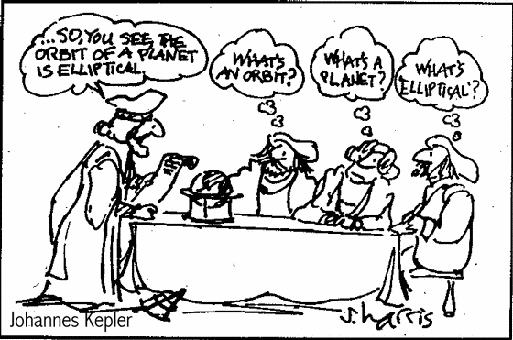
Cohen v. Pesic
Kepler is apparently one of the most polarizing figures in science. Pesic seems to truly appreciate Kepler's methods, and gives him a lot of credit for his unusual way to the truth. It doesn't seem to bother Pesic that Kepler stumbled upon things and made errors that cancelled out.
Cohen, on the other hand, seems like a Kepler hater. He says that "Kepler was a tortured mystic, who stumbled onto his great discoveries in a weird groping." He blatantly says that Kepler could never be mentioned among Galileo or Newton because their methods and "purposeful quests for the truth" could never be described in the terms used to describe Kepler's methods.
Is it important in the sciences to come about things because of "purposeful quests" or is "weird groping" all right for discoveries?
Infinite Complexity
As Pesic makes clear, Kepler’s goal was much like Bacon’s. Both men believed that humans are meant to discover the intricate secrets of nature. As Kepler states about nature, “For these secrets are not to be forbidden…” just as Bacon claims that knowledge of the natural world is unlimited for human beings. Kepler’s discoveries, though, reveal what to me is the beauty of science. Although Kepler’s theories of the solar system simplify and correct the Copernican system, his discoveries pave the way for several scientists (like Newton and Einstein) to discover even more complicated phenomena. Though Bacon, and possibly even Kepler, believed that man could eventually conquer nature, a modern perspective leads me to believe that nature’s intricacies are infinite
Kepler as a Baconian
One passage that I found very interesting in the Pesic chapter relates to Tycho Brahe's obsession with keeping his observations secret and Kepler's response: "Kepler had to sign a document promising to keep secret all information that he was given, though he deplored this practice as an 'evil, shameful custom of the times'; he would have preferred to communicate his thoughts 'to the masters of science so that by their hints I immediately make progress in our divine art.' After his death, Tycho's family hounded Kepler to insure that their proprietary rights were not stolen. Despite (or perhaps because of) this careful secrecy, Tycho himself did not grasp the implications of his own observations" [Pesic, p. 98]. This passage seems to portray Kepler as an exemplary model of the Baconian scientist. In keeping his observations secret, Tycho likely hoped that having sole possession of this data would allow him alone to determine the true model of the universe. However, like a true Baconian, Kepler denounces such an approach and recognizes the need to rely on others for help in unraveling the secrets of the world. Moreover, Kepler is not a slave to tradition and is not afraid even to reject the conclusions of his mentor. Thus, he exhibits the Baconian ideal in that he bases his explanations on what he observes and does not manipulate his data so that it may adhere to some traditionally accepted view. Still, even he cannot break away completely from Aristotelian physics, as his geometric universe demonstrates. His overall approach towards science does, however, reflect many Baconian ideals and does indeed lead to important conclusions that had never been thought of before.
The Astrolabe and Time Zones
When we were working with the astrolabes, I was struck by how it can be used to measure time. Specifically, I was surprised to hear that there was a time factor that we must use to match up the time on the astrolabe and the time on our clock. It made me rather sad that, despite all the progress we have made in the sciences, there are still great errors in our time. In South Bend, we are serious victims of this problem. Because we are on the western end of the Eastern Time Zone, we have very late sunrises and very late sunsets. South Bend is never on its true time, which falls somewhere in between the Eastern and Central Time Zones. It is upsetting to know that we almost never will be living on true solar time. Is there anyway to fix this problem? Or is the inconveniences that would arise from putting people a time that is more precise not be worth living in this more exact time?
Sort of related to Jared's question...
but not really.
As I was reading the Cohen/ Pesic chapters about Kepler, I was examining how great innovators of the past can help and/or hinder a scientist. Cohen mentions Occam's razor at the beginning of the chapter, stating that that which is simplest is best: "Nature does nothing in vain, and more causes are in vain when fewer suffice" (Cohen, 127). However, when one has been bombarded in one's education that circles are the most simple (like Copernicus) or one has been taught only the _Physics_ of Aristotle, perhaps figures such as the one on page 135 does look simple with different Aristotle's five forms for the six planets.
In fact, Cohen states: "Alas, Kepler remained so enmeshed in Aristotelian physics that when he attempted to project a terrestrial physics into the heavens, the basis still came essentially from Aristotle" (147). My question is how much of science is overcoming the biases we're born into and how much is building off the discoveries and information of others?
As I was reading the Cohen/ Pesic chapters about Kepler, I was examining how great innovators of the past can help and/or hinder a scientist. Cohen mentions Occam's razor at the beginning of the chapter, stating that that which is simplest is best: "Nature does nothing in vain, and more causes are in vain when fewer suffice" (Cohen, 127). However, when one has been bombarded in one's education that circles are the most simple (like Copernicus) or one has been taught only the _Physics_ of Aristotle, perhaps figures such as the one on page 135 does look simple with different Aristotle's five forms for the six planets.
In fact, Cohen states: "Alas, Kepler remained so enmeshed in Aristotelian physics that when he attempted to project a terrestrial physics into the heavens, the basis still came essentially from Aristotle" (147). My question is how much of science is overcoming the biases we're born into and how much is building off the discoveries and information of others?
Mathematics divine?
While reading Labyrinth, I was struck by Kepler's view that "geometry is unique and eternal, a reflection from the mind of God." Pesic commented that "Kepler envisioned a bridge connecting the material, earthly world and the celestial realm of geometric knowledge." I found it interesting that Kepler believed mathematics to be a reflection of the divine, rather than something created by man in an attempt to bring order to the universe. I have always agreed with the latter opinion, personally. Does it ultimately matter if mathematics is something divine or manmade?
Approximations ok?
The most important thing I saw come out of the chapters on Kepler was that he was able to escape from the bonds of the celestial spheres based on new, much more accurate, data and postulate the idea of the ellipse. This new data is attributed to his work with Tycho Brahe: “When Kepler eventually became Tycho’s successor, he inherited the largest and most accurate collection of planetary observations – notably for the planet Mars – that had ever been assembled” (Cohen, 135). It was through his belief in the great accuracy of the data that he was able to determine that the other systems had to be wrong. Either the data was wrong, or the previous systems were wrong (Cohen, 136). My question is whether or not this accurate data of Brahe was the crucial step that allowed for the movement away from the theory of everything in the heavens being a perfect circle. Was this new theory of ellipses an innovation that could not be made until there actually was data of the necessary accuracy to suggest this to Kepler? Does this also show the dangers involved in making hypotheses about things before we have the necessary information about them? Is it ok to just make approximations and expect our theories to work?
Monday, October 6, 2008
Kepler's "clue" to the Labyrinth
Pesic emphasizes an interesting part of Kepler's methodology, his ultimately false hypothesis which allows him to negotiate the labyrinth. Kepler himself uses the image of the "guiding thread" through the Labyrinth (104). What is so striking about this image is that Kepler reveals the power of a "vicarious hypothesis", as Pesic puts it, because "the failure of a hypothesis gives more light than its success, for success may be illusory but failure is clear" (105). Kepler himself says, "Be it known therefore, that these errors are going to be our path to the truth"; the idea here is not that errors are a side effect of seeking truth but in Kepler's case, what allows him to really develop his theories. As Pesic puts it, "Kepler's lies are not deceptions, but renewed wrestling" (109). And we see that the process, the wrestling, is incredibly important for Kepler and at times this means that his clue is a sort of labyrinth in itself. I think that what Pesic brings forth about Kepler is important because it shows, rather ironically, how fiction, deception, or a false hypothesis can be a necessary part of truth. It shows the constructive, creative, and inquiring aspect of man's relation to nature.
Kepler's Use of Sexual Metaphor
Like Bacon, Kepler often views the pursuit of knowledge in metaphorical terms of sexuality. While Bacon uses sexual metaphor to describe the implementation of his ideal science, Kepler makes use of such metaphor to describe his personal, mathematical quest to explain the movements of the heavenly bodies. "Kepler views his crescendo of errors and false paths as an extended arousal, whose agonizing delay turns pain into superlative pleasure. This unambiguous metaphor clarifies that his 'seizing' is not a rape or violation, but rather the fulfillment of Nature's seductive teasing" (Pesic 111).
It is apparent that both these men use sexual metaphor to describe their scientific and mathematical interactions with nature. Furthermore, it is interesting to note that while Bacon's use of metaphor incorporates traditional, distinct feminine and masculine sexual roles and qualities, Kepler's is much more unconventional and amorphous: "Whatever joys or sorrows he knew in married life, in his work Kepler mixes masculine and feminine imagery; the fluidity of his desire cannot be confined to conventional sexual roles any more than Mars's orbit conforms to ordinary preconceptions" (112).
In this way, it seems that Kepler's bold, unconventional use of sexual metaphor underscores the pioneering quality of his theories of celestial motion. As Pesic says, "Kepler uses this rich mixture of imagery in order to engage us in a new domain of desire that is informed by the old, but not limited by it" (112).
Sunday, October 5, 2008
The galaxy and Aristotle
During our visit to the planetarium, we saw that our perspective from Earth and more broadly the Milky Way allows us to see distant parts of the universe with more precision than we can see some local parts of the universe. I was interested when thinking about this how Aristotle's view of friendship in the Ethics can be symbolized by our perspective on the universe. Aristotle writes, "we can contemplate our neighbors better than ourselves and their actions better than our own." Perhaps it is a restriction of available technology, but at this point people from another section of the universe might have much more insight into our section than we do. For example, they could see the shape of the Milky Way better than we can. Aristotle similarly says that another person can judge our actions better than we can judge them ourselves. Is this a complete coincidence or is there some kind of cosmic order in this duality of perspectives?
Friday, October 3, 2008
The Copernican System
I was reviewing this past week's readings, and I had a real quick question. In class, we had talked about how although the Copernican system correctly modeled the solar system, the West wished to maintain an Earth-centric view of the solar system. This obviously occurred for several reasons, including the ingrained tradition of the Ptolemaic system as well as the opposition of the Church. At the time of Copernicus, only a handful of individuals bought into his theory. At what point did it become commonly accepted knowledge in Europe that the sun was the center of the solar system?
Science and Aesthetics
It is interesting to me that much of the debate surrounding the Ptolemaic, Copernican and Tychonic systems revolved around aesthetic considerations. For instance, in the Copernican system, "we discover a marvelous symmetry of the universe, and an established harmonious linkage between the motion of the spheres and their size, as can be found in no other way" (Crowe 132). While Brahe himself clearly disagrees with Copernicus' system on the basis of the three principles that he sets forth, he couldn't help but attribute "a greater elegance to the Copernican system and admitted that it 'does not at all offend against mathematical principles'" (140).
I suppose that this sort of premium that was placed on elegance and harmony may have originated with the Platonic notion of the harmony of the spheres. Meanwhile, I find myself wondering how much of an influence aesthetic considerations have today with regard to the formulation of hypotheses and general modes of scientific thought.
some final thoughts on save the phenomenon
Just to say a few more thoughts on our reading for Wednesday...While I do think that having a certain cognizance of our place in the universe and how much we can really know about it is important (or at least a recognition that it's a gradual learning process), it also worries me that this idea of "Save the Phenomenon" can backfire. If you say "save the phenomenon" about astronomy, couldn't you say that about anything? Proclus says, "The astronomers who are eager to prove the uniformity of celestial motions are in danger of unconsciously proving that their nature is irregular and full of changes." Even if the rebuttle argument is that well, this is only about astronomy, how can you live in a world where the phenomena around you is completely incomprehensible, despite attempts? Would people like Proclus not find any significance in the fact that mathematics do at least seem to explain astronomy, at least until the next theory?
Wednesday, October 1, 2008
Tycho's Uraniborg and Bacon's New Atlantis
I was struck by one of Professor Goulding's final comments today in class. He mentioned that one of Tycho Brahe's greatest contributions to astronomy was the extensive compilation of observations that he gathered with his team of mathematicians and astronomers. This was so powerful because the research and recording (including his mural) was incredibly accurate (for pre-telescopic observation) and far-reaching. I thought that this was interesting because it made me think of Bacon's methodology and vision. Is it just me or does the picture of Tycho orchestrating a huge team of scientists who were constantly observing and recording data look something like what we saw in the New Atlantis. Also, setting aside the question of how Tycho was engaged in the save the phenomenon idea, how was Tycho's form of observation, recording data, and drawing conclusions like or unlike what Bacon envisioned as a new methodology in natural philosophy?
Ptolemaic animations
The animations I've used in class can all be found here. (If you're using Firefox as your browser, you may need to use the "Netscape" versions on that page). There are a lot of animations to look through, as well as some lecture notes etc. on Ptolemaic and Copernican astronomy. I do recommend that you spend some time exploring it.
If I had been able to get my computer to work on the projector today, I would have asked you to look at the animation of the sun, in particular: you can switch between the equivalent eccentric and epicyclic models. This is important for the issue of "saving the phenomena": if two hypotheses produce identical results, it would seem to be impossible to assert that either was "true."
Also take a close look at the animations of "transformation between a geocentric model and a heliocentric model" for both inner and outer planets. With these animations, you can switch between an epicyclic (Ptolemaic) model, eccentre model (used by some of Copernicus's successors, trying to "re-geocentrize" his astronomy), Tychonic and heliocentric models.
Finally, here there is a quite sophisticated Flash app that allows you to play with all the parameters of a planetary model, and see how it effects the planet's motion in longitude.
Enjoy!
If I had been able to get my computer to work on the projector today, I would have asked you to look at the animation of the sun, in particular: you can switch between the equivalent eccentric and epicyclic models. This is important for the issue of "saving the phenomena": if two hypotheses produce identical results, it would seem to be impossible to assert that either was "true."
Also take a close look at the animations of "transformation between a geocentric model and a heliocentric model" for both inner and outer planets. With these animations, you can switch between an epicyclic (Ptolemaic) model, eccentre model (used by some of Copernicus's successors, trying to "re-geocentrize" his astronomy), Tychonic and heliocentric models.
Finally, here there is a quite sophisticated Flash app that allows you to play with all the parameters of a planetary model, and see how it effects the planet's motion in longitude.
Enjoy!
Brahe's Account
I know there was still the conception, at the time of Brahe, that astronomy had a more descriptive than explanatory nature, however does Brahe offer an explanation as to why his is superior. Copernicus' seems simpler. Can Brahe give an account of why only the moon and sun should revolve around the earth, and why the rest of the universe revolves around the sun? He seems to be adding a level of complexity to Copernicus' system. Is this merely a 'save the phenomena" claim, or does he have a causal explanation as to why this would be more true than Copernicus' account?
Methodical relativity
I think it's important to keep in mind that all of these astronomical viewpoints represented entirely different approaches and dogmas. In response to some of the previously posted comments, it would have been doctrinal madness to try to combine them, blasphemous in some cases. What I'm confused about is how the Tychonic system could ultimately have the same mathematical results as the Ptolemaic one. It's kind of funny to see how much importance astronomers gave to particular method and calculations, and yet see their products end up the same despite having conjured entirely different hypotheses. It's also interesting that theoretical knowledge could have held so much more value than empirical knowledge did at some point in time, in comparison with the modern scientific approach.
Brahe's "new and ingenious" system
In class on Monday, we heard how for decades astronomers were trying to figure a way to use the good things in Copernicus's system with the good things in Ptolemy's. I am curious why it took so long in figuring out that you can just combine them. I can imagine Brahe telling a friend, "I have an idea, why don't we have everything rotate around the Sun because you know Copernicus' made that seem pretty simple. But Ptolemy had the right idea about the geostatic thing, so we'll just have the sun then circle us." His friend would reply, "Brilliant! Why didn't I think of that?" And I'm pretty sure Brahe's response would be the same as my question: "I don't know, why didn't you?"
But I guess hindsight is 20/20, perhaps the reason that's the case is because there is no nose to obstruct our view while we look back.
But I guess hindsight is 20/20, perhaps the reason that's the case is because there is no nose to obstruct our view while we look back.
There are many scientific 'theories', but not many scientific 'laws'...
I found Crowe's statement, "...the problem of observational accuracy alone is sufficient to understand why so many medieval philosophers were reluctant to conclude for the absolute truth of mathematical devices" interesting, especially is light of several of the pervious blogs.
Courtney asks to what extent instrumentalism is present in science today. I feel that it is more present than we like to think. Take for example the idea of 'theories' v. 'laws' in most scientific disciplines. Very rarely do we come across actual laws in science b/c (as in the famous example of the pen tapping the table and finally going through the table in the million-and-second tap) scientists (or maybe just physicists) find it difficult to label anything certain. There always seems to be room for doubt. This mentality is not instrumentalism exactly, but I feel it could trace its lineage back to the 'save the phenomena' philosophy.
Subscribe to:
Posts (Atom)
