Sunday, November 30, 2008
Is there room for absolute space or time?
Is there no room for absolute space and time on which everything is compared? Einstein says: “the time required by a particular occurrence with respect to the carriage must not be considered equal to the duration of the same occurrence as judged from the embankment (as reference-body). Hence it cannot be contended that the man in walking travels the distance w relative to the railway line in a time which is equal to one second as judged from the embankment” (33). I understand the difference he is stating from one viewpoint to another, but my question is whether or not there would be a difference as considered from a ‘bird’s-eye’ view taken from the perspective of absolute space or time. Why cannot one abstract himself from his reference point to consider these motions? Or is this the problem he discusses earlier of making theoretical geometry work in real situations and be proven by experiments?

Einstein lost me
So here is a question regarding our reading, maybe some of you ran into the same difficulty.
In section V, Einstein lays out the principle of relativity (in the restricted sense): "If relative to K, K' is a uniformly moving co-ordinate system devoid of rotation, then natural phenomena run their course with respect to K' according to exactly the same general laws as with respect to K."
In section VII, Einstein gives an example that contradicts this principle. He describes a scenario where the railway carriage is traveling along the lines at velocity v from which a light is shone which has constant velocity c. The "required velocity of light with respect to the carriage" is then c - v.
Einstein says that this comes into conflict with the above principle of relativity: "For, like every other general law of nature, the law of the transmission of light in vacuo must, according to the principle of relativity, be the same for the railway carriage as reference body as when the rails are the body of reference.
Now, I think Im missing something here. Possibly that this is based on the proposition that light is a constant c, which seems totally separate from the principle of relativity. That is to say, I understand how having a constant c is in conflict with the theory of relativity, I just dont understand how Einstein phrases his argument. Is it just that he is employing a vacuum as the first frame of reference? Isnt this an unfair frame of reference to compare the moving train to?
Einstein Following Newton's Lead
It seems to me, in his discussion of the theories of special and general relativity, that Einstein is following the rules of philosophizing that Newton laid down in his Principa. Indeed, as I discovered in my research paper, these laws Newton used in all his investigations including his work in theology and alchemy. These laws were essentially to keep explanations brief, harmonious, simple, and to add nothing to theory that is not supported by experiment or direct observation. Einstein is obviously brief in his explanations (i.e. his chapters are short and to the point). He is obsessed with keeping things simple as well, as he notes in the last paragraph on pg 23. He does not want to make exceptions to the law regarding the promulgation of light, or make them any more complicated than is necessary. Also, in the first paragraph on pg 24 he writes that theoretical physicists rejected relativity, in spite of the fact that they had no empirical evidence on which to object. All evidence pointed to a simple, general, uncomplicated theory, and Einstein wished to explain it following Newton's example.
It's all relative...
This is a response to Maddy's post... sort of.
I noticed in the Einstein readings how much language factors into the way we observe the world scientifically and how fixed the human mental schema is. It seemed to me, that often times, Einstein/Infeld challenged us to question what we always held to be true. For example, in Chapter 8 of Relativity, Einstein asks us to think about whether lightning can strike the rails simultaneously. Although on first impulse we answer 'yes,' when we think about the question 'more precisely' we find a different answer, but it requires questioning what 'simultaneous' means.
It seems to me like Einstein was not afraid to question assumptions in order to avoid allowing it to inhibit his scientific progress and examining the world in a very precise way. Also what does Einstein's thought process imply about scientific truths? How does this change the way we thought of the world before? Galileo also challenged preconceived notions; what made Einstein less "dangerous?"
Language and Science
In the Einstein Infeld reading for tomorrow there is a lot of talk about language and putting things in terms of "field language".
"A new reality was created, a new concept for which there was no place in the mechanical description...it is rather like climbing a mountain, gaining new and wider views, discovering unexpected connections between our starting point and its rich environment. But the point from which we started out still exists and can be seen, although it appears smaller and forms a tiny part of our broad view gained by the mastery of the obstacles on our adventurous way up... we may still use the word ether, but only to express some physical property of space. This word ether has changed its meaning many times in the development of science. At the moment it no longer stands for a medium built up of particles. Its story, by no means finished, is continued by the relativity theory." (pgs 151, 152, 153)
What I want to draw attention to is the way that Einstein and Infeld emphasize physical science as a discourse and that these realities exist for scientists and theorists in language and are brought forth for others in language. It is interesting for me to reflect on how much I consider science to be ideas brought forth only through language or how much I consider it to be just the way things are? I think that Einstein and Infeld are able to remind us how inherently philosophical science is. Any thoughts?
Fun Stuff
Hi everybody.
So I'm sitting in the airport waiting for my flight back, and I'm reflecting on my past flying experiences. I am always amazed by seeing the horizon from an airplane. I think it's a really neat experience to be able to see the curvature of the earth. And I think this is an example of how science helps us to appreciate the beauty of nature, as suggested by James Thomson (the second poet from the poetry about Newton packet). Without knowing that the earth is curved, it would be hard to appreciate, or even to notice, how beautiful the horizon looks from the air.
Secondly, tomorrow, Monday, December 1, Venus will be directly below Jupiter. Venus will appear at its brightest. There will also be a tiny sliver of a moon in the general vicinity of Venus/Jupiter. I was able to see this phenomenon last night and it was pretty cool.
If you have trouble seeing Venus tomorrow because of light pollution, don't feel alone. November's National Geographic cover story is about how light pollution affects more that just astronomers. Apparently, light pollution is harmful for the entire ecosystem, just like other forms of pollution. It affects many animals mating and migration schedules. Worth a read.
One more thing. I was reading an article about Paul Volcker, Obama's appointee as head of a new economic recovery advisory board, on Politico the other day. It seems that Volcker embraces some of Newton's principles of philosophizing: "Associates say Volcker does not suffer complex economic solutions, figuring anything that’s too complicated to understand is probably wrong." Sounds a lot like astronomy--if it involves epicycles, it's probably wrong.
Friday, November 28, 2008
Limitations Imposed by Relativity
I suppose my biggest concern with the theory of relativity has always been that it seems to render much of conventional (or perhaps classical) scientific inquiry in the field of physics irrelevant. Relativity places limitations on the importance of scientific findings by restricting their applications to very specific contexts. It seems that the only thing one can do is recognize these limitations with regard to application and strive to arrive at the best conclusions one can under the circumstances. Perhaps this question is a bit premature in light of our future readings, but is there any way to get beyond these limitations and obtain physical results that are more widely applicable?
Monday, November 24, 2008
Fists
Sorry, this may be unnecessary but does anyone have a clue why Coppelius is described as always having fists and never hands? Could it be because hands are a symbol of human art and beauty? Any thoughts...
Sandman
A stop-motion animation of the terrifying story that Nathanael heard from his nurse:
(This short animation was nominated for an Oscar in 1991).
A bit of Googling informs me that my erstwhile favorite obscure rock band, The Residents (whom I kind of lost track of in the mid-nineties, after many years of true obsession) just released a narrative album The Voice of Midnight, based closely on Hoffmann's "Sandman." It's supposed to be pretty lousy, as much of their recent stuff is (in my opinion...); has anyone heard it?

Land color constancy
In the second section today, I mentioned the famous experiments done by Edwin Land in the 50s and 60s, in which color photographs were reduced to grayscale, then projected through red (or other monochromatic) filter. Surprisingly, the colors of the original photograph were perceived, even though those colors were missing from the projected images. (The same effect was observed with abstract, Piet Mondrian-like slides -- it was not limited to naturalistic photos).
The resonances with Goethe's theory are obvious. It is interesting that Land (CEO of the Polaroid Corporation!) was a scientist much in Goethe's mold, given to intense, open-ended exploratory experimentation. This point is made in an excellent Physics Today article available here, which I would like you to read.
I've only been able to find one "color constancy" slide on the internet:

This picture of a hamburger is filtered through a red filter -- only the color red is "there" -- but we clearly perceive the green of the lettuce and the brown of the burger. The green in particular is very striking -- no green light is coming from your monitor, but there is green in the picture nevertheless.
The resonances with Goethe's theory are obvious. It is interesting that Land (CEO of the Polaroid Corporation!) was a scientist much in Goethe's mold, given to intense, open-ended exploratory experimentation. This point is made in an excellent Physics Today article available here, which I would like you to read.
I've only been able to find one "color constancy" slide on the internet:
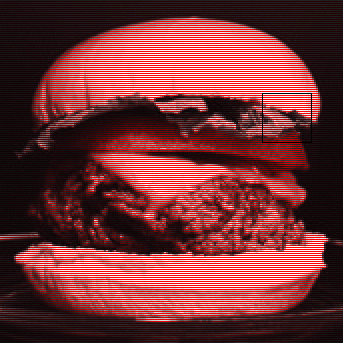
This picture of a hamburger is filtered through a red filter -- only the color red is "there" -- but we clearly perceive the green of the lettuce and the brown of the burger. The green in particular is very striking -- no green light is coming from your monitor, but there is green in the picture nevertheless.
Sunday, November 23, 2008
Being like a child
I'm still relatively puzzled by "The Sandman," and I wonder what Hoffman's references to childhood mean. For instance, Clara is described as childlike and while Nathaniel is healed, he is also described as returning to the childlike state from which he had to depart when he encountered "the Sandman."
Perhaps Hoffman was encouraging a more innocent and less scientific view on nature, enjoying nature for what it is instead of trying to take it apart with spectacles. Olimpia was beautiful if you look at each of her physical qualities individually, but holistically, there was always something off about her (e.g. her eyes, her gait, etc). This story seems to me as a reversal of stereotypes. We usually poets as the more emotional beings, but Clara is much more practical than the learned Nathaniel. In the Goethe color theory article, he describes his curiosity as child-like when he picks up the prism and he was a poet in addition to being a scientist. What characteristic in being a child do these authors admire?
Perhaps Hoffman was encouraging a more innocent and less scientific view on nature, enjoying nature for what it is instead of trying to take it apart with spectacles. Olimpia was beautiful if you look at each of her physical qualities individually, but holistically, there was always something off about her (e.g. her eyes, her gait, etc). This story seems to me as a reversal of stereotypes. We usually poets as the more emotional beings, but Clara is much more practical than the learned Nathaniel. In the Goethe color theory article, he describes his curiosity as child-like when he picks up the prism and he was a poet in addition to being a scientist. What characteristic in being a child do these authors admire?
But Why Sandman?
I agree with Stephanie's understanding of the Sandman, however I think that Coppelius is meant to symbolize something else. It is strange that he reappears in the story as a barometer salesman. Overall, I am just very confused as to he wrote this allegory, and most of all, why he called it the Sandman.
I suppose Sandman could be a reference to the way that scientists can throw sands in your eyes and confuse or blind you as Nathaniel was blinded.
Sandman
I am on the same page with Mike. I am not quite sure how to read the short story "The Sandman" by E.T.A. Hoffman. I do, however, have a theory based on the context of German Romanticism in our discussions from class, especially in relation to the discussion of how Newton ruined the appreciation of the rainbow.
For me, in the story, Nathaniel's father and Coppelius represent the scientists like Newton, probing for the secrets of Nature. As Clara writes in her letter to Nathaniel, "I expect the two of them were simply conducting secret alchemical experiments, which could hardly please your mother, since a lot of money must have been squandered and moreover, as is said always to happen to such inquiries, your father became obsessed with the delusive longing for higher wisdom and was estranged from his family" (94).
Nathaniel represents the Romantic poets, who would prefer to live in the imaginary world of their childhoods, failing to come to grips with the reality of science in the world.
Clara is obviously the voice of reason in the story, trying to help Nathaniel to stay attached to reality.
Olimpia would represent the rainbow, the mirage of beauty with unknown origin. For Nathaniel (and the poets), this mirage is taken at face value. For the other men at the ball, they feel there is something strange about Olimpia (especially her lifeless eyes), as Siegmund sates "we felt that she was only pretending to be a living being" (111).
Nathaniel once again tries to combat this opinion by saying that "it is only to the poetic soul that a similarly organized soul reveals itself!" (111).
Thus, I believe if the story is read in this context, we can see the allegorical critique of the Romantic poets vs. the scientists such as Newton.
The Sandman?
I have to admit that I'm not sure I completely understand the meaning and context of the story "The Sandman". Is Nathanel's comical yet tragic experience with Olimpia supposed to be an indication of the importance of determining to what degree our senses can be deceived? In this case, the story would seem to emphasize our ability to approximate such a determination through the science of optics. I suppose that this is why philosophers such as Descartes must have been so interested in the science of optics. It makes sense that Descartes, who begins his Meditations by disregarding all of his a posteriori knowledge and doubts his senses, would want to determine precisely how and with what degree of accuracy these senses perceive the material world.
Friday, November 21, 2008
Wednesday, November 19, 2008
Newton apparently conquers all
Two things about the readings surprised me: in the "Ode on This Splendid Ornament" there is a great emphasis on the fact that Newton has conquered everything there is to know in nature, "Heaven has been conquered and its innermost secrets are revealed." This would not be that surprising except that the poem suggests that these laws that Newton has discovered are things that "that creator of all things, while he was setting the beginnings of the world, would not violate." This goes beyond your typical idea of conquering nature - this seems to infringe on the omnipotence of God. God is contained within nature and Newton has discovered all of this. Something else that I found surprising was the emphasis on simplicity that Thomson found in Newton's science and the beauty in that. This returns to the idea that the simple is beautiful and it describes the divine, but I thought that the point was that despite its simplicity, there was still a mystery about it. Thomson states "from Motion's simple laws/Could trace the secret hand of Providence."
Negative Capability
I find it interesting, maybe even a bit sad, that Keats thought that Newton ruined the poetry of a rainbow by reducing it to a prism. I wonder if this statement could be better understood when considered alongside his theory of Negative Capability, which he describes in his letters as "when a man is capable of being in uncertainties, mysteries, doubts, without any irritable reaching after fact and reason." It seems to me that Keats would find Newton guilty of "irritable reaching after fact" and destroying a beautiful mystery.
Consequences of Newtonian Mechanics
The things that so often vexed the minds of the ancient philosophers
And fruitlessly disturb the schools with noisy debate
We see right before our eyes, since mathematics drives away the clouds
Error and doubt no longer encumber us with mist;
For the Keenness of a sublime intelligence has made it possible for us to enter
The dwellings of the gods above and to climb the heights of heaven.
- Excerpt from Halley's ode to Newton
I think this excerpt presents some of the serious idealogical consequences of Newton's view that the Romantics (and I would wager many PLS students including myself) are afraid of, but is there good reason to be? I think this passage (and the entire poem) can be interpreted to say that mathematics has replaced philosophy and that we are able to know the mind of God through it. I think this would be hard to argue against, but what Im not convinced about is whether Halley sees no place for philosophy. Do you think that Halley believes that philosophy is only replaced when it comes to natural science, or does the Newtonian mechanistic approach to the world apply to all things?
Two Cultures or Just Ideological Backlash?
I think that many of us feel that there is a tension between the Romantics and Newton and that this might be indicative of the "two cultures" that Snow was talking about. Does this necessarily justify Snow's arguments, though? Newton's work was revolutionary and changed man's outlook on the world. With his physics, all motion and actions become deterministic. Nature no longer feels as free and unpredictable. Although the Romantics rail against him, does this necessarily mean that the arts are antithetical to science? Perhaps, this is just an ideological backlash, a cultural trend if you will. For example, the development of radical political ideals will spark a backlash among another group of people. Of course, this would lead one to ask whether it is inevitable for the literary culture to always backlash against the scientific culture? I would say no. Some have posted before me that the sciences provide more material for the poet to work with. I think some poets would find the advancements of sciences very interesting. I think this works the other way around as well, too. Newton sets up his physics as a philosophy, even a theology. He believes that his science is philosophical and delves into the nature of God. Can a science be poetic? Perhaps.
Tuesday, November 18, 2008
Another instance of two cultures?
I find it interesting that the poets who seem to understand Newton best, also seem to have an affinity towards him. For instance, it is pretty clear that Thomson was relatively well versed in Newton's works, and thus had a much greater appreciation for them. Coleridge also has a certain respect for Newton, however he acknowledges that he does not yet understand all that he has written.
I feel like this might be another example of two cultures not understanding each other. If a scientist made a monumental discovery today and was receiving all kinds of publicity, but I didn't understand the significance of the discovery, I wouldn't be very inclined to appreciate it either.

It's not so bad
I did not see the Romantic poets as being as negative towards Newton as everyone else seems to think they were. It is true that Keats and Co. lament that Newton has reduced the beauty of the rainbow by reducing it to a prism, but yet Newton did open up a whole new arena in which poetry could operate. In fact, many of these poets seem to be finding poetry in the very discoveries of Newton themselves. Thomson says “Did ever poet image aught so fair, Dreaming in whispering groves, by the hoarse brook! Or prophet, to whose rapture heaven descends? E’en now the setting sun and shifting clouds, Seen, Greenwich, from thy lovely heights, declare How just, how beauteous the refractive law.” Thomson seems to almost deify Newton and his accomplishments. Blake also seems to place reverence on actual science and knowledge as opposed to “the idiot questioner who is always questioning But never capable of answering.” Even further than this, by advancing knowledge forward, more than anything else, Newton has opened up far more mystery and beauty to write about than there was before his time. After Newton the philosopher or the poet can now muse on what is this strange phenomena of gravity, or absolute space or time. In fact, things were much simpler and less was left to the imagination just a few years before when the universe was explained by blind faith in the descriptions of the Bible. More questions are raised the further knowledge progresses, providing more and more subject matter on which to ponder.
Newton's "cogs tyrannic"
I'm in the same boat as Mike in that, while I do not agree with them, I can understand why the Romantics may have disliked Newton. One of the major aspects of the Romantic movement was a strong emphasis on the beauty and mysteriousness of Nature. Given this perspective, I can see why Keats may have felt that the experience of a rainbow is cheapened if one can simply say, "it's just light refracted through water." Still, one part of William Blake's Jerusalem really did bother me: "cruel works / Of many Wheels I view, wheel without wheel, with cogs tyrannic / Moving by compulsion each other: not as those in Eden: which / Wheel within Wheel in freedom revolve in harmony and peace." The laws of physics that Newton discovered are indeed "tyrannic" in that they are absolute and cannot be contradicted. The opposite of such laws, then, would be "cogs anarchic," or laws that are not fixed (or perhaps no laws at all) However, a universe that revolves around these "cogs anarchic" hardly seems compatible with "harmony and peace" much less with perfection i.e. Eden. Rather, a universe that has no fixed structure to it would be much more likely to produce "cruel works," since nothing could ever be predicted with absolute certainty.
Adding to Mike Wrapp...
I too was struck by the poets' dislike of Newton and wondered why so many of these poets criticized him (Like Keats saying "Do not all charms fly / At the mere touch of cold philosophy?") when poets seemed so positive about previous scientists (Milton praised Galileo, I think).
When I read Halley's "Ode to Newton" I noticed that he used a lot of religious imagery. He said how fear was banished by knowledge and talked of making it possible for humans to "enter / The dwellings of the gods above and to climb the heights of heaven." This image sounded like a reversal of the Tower of Babel story in the Bible and opening "the treasure chest of hidden truth" sounded like Pandora's box. Halley made these images into positive statements about Newton but Blake seems to think that Newton limited human imagination. Since poets and scientists are both striving to see the truth, the poets in this selection seem to think that Newton went too fair in his explanations, leaving no mystery to ponder. Did our readings in the _Principia_ give you this impression? Do poets and scientists really ponder abou the same mysteries?
When I read Halley's "Ode to Newton" I noticed that he used a lot of religious imagery. He said how fear was banished by knowledge and talked of making it possible for humans to "enter / The dwellings of the gods above and to climb the heights of heaven." This image sounded like a reversal of the Tower of Babel story in the Bible and opening "the treasure chest of hidden truth" sounded like Pandora's box. Halley made these images into positive statements about Newton but Blake seems to think that Newton limited human imagination. Since poets and scientists are both striving to see the truth, the poets in this selection seem to think that Newton went too fair in his explanations, leaving no mystery to ponder. Did our readings in the _Principia_ give you this impression? Do poets and scientists really ponder abou the same mysteries?
Romantic Poets' Dislike of Newton
Although I don't necessarily agree with them, I think that I can understand the Romantic poets' dislike of Newton. As we discussed on Monday, Newton strives to avoid the rather occult notion of substantial properties, which essentially add a sense of ignorance, mystery and ambiguity to scientific theories. Even in his study of more abstract subjects such as theology, it seems that Newton was very methodical. This is evidenced by his belief that one should consistently make use of one method of interpreting scripture.
I think that the Romantic poets find it hard to identify with Newton's precise, methodical way of thinking and working. As poets, these men thrive on ambiguity and a sense of ineffable mystery, while Newton's work typically seeks to eliminate any room for doubt or speculation. As Keats says in his narrative poem Lamia, "Philosophy will clip an Angel's wings,/ Conquer all mysteries by rule and line,/ Empty the haunted air, and gnomed mine". It seems to me that Newton and the poets may already be members of a kind of intellectual divide such as the one that Snow discusses in The Two Cultures, in that they experience the world in fundamentally different and distinct ways.
I think that the Romantic poets find it hard to identify with Newton's precise, methodical way of thinking and working. As poets, these men thrive on ambiguity and a sense of ineffable mystery, while Newton's work typically seeks to eliminate any room for doubt or speculation. As Keats says in his narrative poem Lamia, "Philosophy will clip an Angel's wings,/ Conquer all mysteries by rule and line,/ Empty the haunted air, and gnomed mine". It seems to me that Newton and the poets may already be members of a kind of intellectual divide such as the one that Snow discusses in The Two Cultures, in that they experience the world in fundamentally different and distinct ways.
The Romantic Distaste for Newton
I had a really hard time understanding the Romantic poets' dislike of Newton. This dislike was exemplified in Haydon's recount of the dinner party where Keats offers a toast to "Newton's health, and confusion in mathematics." The reason that Keats say he doesn't like Newton is, "[Newton] had destroyed all the poetry all the poetry of rainbows by reducing it to prismatic colours." This kind of dislike for a true understanding of the nature of things disturbs and seems counterintuitive to me. Maybe this is just me, but understanding the inner complexity of a rainbow makes an even more impressive phenomena and allows me to have a deeper appreciation for its beauty. I have a hard time understanding why ignorance of physical phenomena is proportional to appreciation of its beauty?
Two Cultures Survey
Hi guys, here is the link again to take a very very short survey that I put together for my research paper on whether or not there are two cultures at Notre Dame. Thanks, I appreciate your help!
http://www.surveymonkey.com/s.aspx?sm=yQvaMYlrN8mBEppBuAnYqg_3d_3d
This is a shorter link that may be easier to click to - RG.
http://www.surveymonkey.com/s.aspx?sm=yQvaMYlrN8mBEppBuAnYqg_3d_3d
This is a shorter link that may be easier to click to - RG.
Monday, November 17, 2008
Faraday and electric current
In one of the final paragraphs of Fisher's introduction to his work on Faraday, he talks about the connotation of positive and negative currents. He writes:
"It being then impossible to establish conclusively the number and identity of electrical fluid or fluids, partisans of electric fluid imagery had little choice but to assign a current direction arbitrarily, by convention. The convention adopted was positive to negative, a convention that remains in force today" (27).
This struck me as a bit absurd. I don't understand why something like this could just be conjectured and kept part of scientific theory for hundreds of years. Maybe I am putting too much emphasis on this passage, but it struck me as strange and similar to the occult properties we were talking about in class today.
basketball and isaac newton. true story.
"Sir Isaac Newton's first law of motion came about two centuries ahead of basketball, so he had no inkling of men who would look like Shaquille O'Neal or teams that would move a sphere like the Suns.
But there they were Sunday night, bringing a physics lesson in how O'Neal's size and force created a big lead and garnered an ejection that could not prevent the Suns' inertia from a 104-86 win against Detroit."
--from the Arizona Republic, November 17, 2008.
But there they were Sunday night, bringing a physics lesson in how O'Neal's size and force created a big lead and garnered an ejection that could not prevent the Suns' inertia from a 104-86 win against Detroit."
--from the Arizona Republic, November 17, 2008.
Sunday, November 16, 2008
the genius catch-22
According to both Pesic and Keynes, Sir Isaac Newton's genius seems to have been both a blessing and a curse. For as much as Newton contributed to scientific understanding, he was acutely aware of all the knowledge he lacked. It must have been like torture to have been a man brilliant enough to comprehend that larger puzzles existed in the universe, and yet not brilliant enough to figure them all out.
Newton's alchemy
Bill Newman, a scholar at IU and one of the world's leading experts on the history of alchemy, has been not just editing Newton's alchemical manuscripts but also reproducing several of his experiments. A webpage for his project is here. Be sure to look at the "Chymical Experiment Products."
Nova has made a documentary about Bill, Newton and the experiments. If there is any interest in this, I will show it one evening (entirely optional attendance).
Nova has made a documentary about Bill, Newton and the experiments. If there is any interest in this, I will show it one evening (entirely optional attendance).
Proving God through the material universe
This is similar but not the same idea that Kate expressed in her post. I was just surprised to see that Newton did try to prove God through nature. Keynes said that he was a "magician" because he sought to read the divine through the study of the material universe (Pesic expressed similar views and also called him a magician). But it struck me that there could be dangers in doing this and reducing God to a "hypothesis" of causing physical phenomena. While it is possible to explain that God is the cause of the planets rotating around the sun because He pushed them, if one is able to describe that phenomena more accurately, then you do not need God for that any more. As a result you would keep on pushing God to a smaller and more narrow sphere. Eventually it might seem that God is not necessary anymore because it would be easy to fall into the belief that science will be able to explain everything. And in fact this view was taken up throughout the Enlightenment. I find it really interesting that when Newton tried to prove God and increase belief in him, he in fact started a reduction in faith in God and increased a blind faith in the sciences.
Newton: Causes
“And it is enough that gravity really exists, and acts according to the laws set forth by us, and is sufficient [to explain] all the motions of the heavenly bodies and of our sea” (General Scholium, pf 96).
As Pesic points out this ending, which “sets the deeper questions aside as impertinent to the real project of prediction, which can go forward without any need to know the ‘cause,’” is both brilliant and frustrating. This is an important move for Newton and for all who follow him because it allows them to work with the mechanics of something and talk about the forces without having to explain their causes because it is enough that the forces exist and manifest themselves the way they do. I guess I keep coming back to how occult the idea of the force of Gravity really is and I feel that I accept it more easily because of my modern sensibilities. To me, the fact that it exists and acts isn’t 'enough'… I want to know what 'causes' it.
As Pesic points out this ending, which “sets the deeper questions aside as impertinent to the real project of prediction, which can go forward without any need to know the ‘cause,’” is both brilliant and frustrating. This is an important move for Newton and for all who follow him because it allows them to work with the mechanics of something and talk about the forces without having to explain their causes because it is enough that the forces exist and manifest themselves the way they do. I guess I keep coming back to how occult the idea of the force of Gravity really is and I feel that I accept it more easily because of my modern sensibilities. To me, the fact that it exists and acts isn’t 'enough'… I want to know what 'causes' it.
Hypothetically speaking, is it really enough?
I wanted to bring up two things from the second to last (penultimate, you might say) paragraph from Newton's General Scholium in Book III. First, his use of the word "hypothesis" seems to be quite different from what we've seen this far. He says, "I do not contrive hypotheses. For whatever is not deduced from the phenomena is to be called a hypothesis, and hypotheses...have no place in experimental philosophy" (96). By "hypothesis," he seems to mean something like a "guess." In effect, he is saying, "I'm not going to guess at the reasons for my observations." He wants reasons, proofs. It's interesting that he says hypotheses don't have a place in experimental philosophy, because, at least as I learned it, modern scientific method involves starting with a hypothesis (in the form of an "if...then..." statement), which is then tested through experiments. The hypothesis is actually quite important for the whole process. Hypothesis in this sense seems not be exactly what Newton means, but not too far off, since in this sense it's sort of a "best, educated guess."
Second, he says, "And it is enough that gravity really exists, and acts according to the laws set forth by us...." According to the context, you could add "even though we don't really know what gravity is,..." to the beginning of that statement. My question to Newton and to the class is, "Is it really enough?" Sure, it's sufficient to explain and predict various phenomena, but I think Newton really wants to know what exactly gravity is. The quotation that Pesic uses (about Neewton on the beach) brings this out. Like all wise thinkers, he knew (or at least had an idea) how much he did not know.
Second, he says, "And it is enough that gravity really exists, and acts according to the laws set forth by us...." According to the context, you could add "even though we don't really know what gravity is,..." to the beginning of that statement. My question to Newton and to the class is, "Is it really enough?" Sure, it's sufficient to explain and predict various phenomena, but I think Newton really wants to know what exactly gravity is. The quotation that Pesic uses (about Neewton on the beach) brings this out. Like all wise thinkers, he knew (or at least had an idea) how much he did not know.
Form of the Principia
According to my count, the Principia is composed of prefaces, definitions, scholia, axioms or laws, propositions, rules of philosophizing, and phenomena. Why does Newton use these various forms in his writing? What does he gain by doing this instead of just writing in a standardized form?
Keynes and Newton
Keynes article regarding Newton is less than complimentary, and is was likely much of the inspiration for Dan Brown's Da Vinci Code. Its interesting having watched the movie immediately before we started our readings of Newton (and completely coicidentally I might add). Brown echoes Keynes attitude to Netwon as that as a magician and a man of riddles, as his infamous crytogram makes an appearance in both novel and movie. If have been reading Newton through the lenses of Euclid, as a rational mathematician. Yet these two men (Brown and Keynes) have managed to twist the image of the man Newton and mold him into a mystical character of sorts. Newton does indeed appear abnormal, but don't we often ascribe this as the price of genius rather than assigning it a mystical aura?
God and Science
As Iread the Scholium of Newton, I found it interesting that despite all his mathematical proofs still returned to God as an unmoved mover of sorts. It surprised me that the same author who wrote such cold, rational proofs could claim so matter-of-factly that it was probable to him "that God in the Beginning form'd Matter in solid, massy, hard, impenetrable, movable Particles, of such Sizes and Figures, and with such other Properties, and in such Proportion to Space, as most conduced to the End for which he form'd them" (400).
After reading about Galileo who claimed that those who read the Scripture literally read it falsely, I wondered if unraveling the mysteries of nature means unraveling the mysteries of God. Can religion and science can ever be separated? Should they be?
After reading about Galileo who claimed that those who read the Scripture literally read it falsely, I wondered if unraveling the mysteries of nature means unraveling the mysteries of God. Can religion and science can ever be separated? Should they be?
Saturday, November 15, 2008
Variance in Social Tendencies of the Great Scientists
It is interesting to note the great variations in the social tendencies and attitudes of some of the great thinkers and scientists that we have studied. While Newton seems to have been incredibly antisocial and reluctant to even share his work with others, Galileo seems to have enjoyed his celebrity status and taken great pride in displaying his work. Could Galileo's relish of his celebrity status have sometimes been a distraction from his search for astronomical data? At the very least, it contributed to the Church's decision to bring him to trial, which must have provided a significant source of distraction from his work. Did Newton ever attain a sort of 'celebrity' status during his lifetime for his discovery of calculus and his ability to chart out the motion of the planets, among other feats? It seems that his hesitance to publish his work would have prevented him from reaching the sort of fame that Galileo enjoyed. In any case, is it logical to conclude that Newton may have been able to accomplish more as the recluse that he was than he would have as a more social celebrity?
Friday, November 14, 2008
System of the Worlds
In his principia, Newton says that he has presented principles of philosophy through mathematics and established a system of the world by treating things like density, resistance of bodies, spaces void of bodies, and motion of light and sounds (57). He did this with the idea of absolute space and time. I just thought it was interesting that Cohen that "the student should not make the mistake of thinking that the framework in which the system originally was set is equally valid" (182). Newton's system of the world was discredited by Einstien's relativity. What I find interesting is that Einstein's relativity also discredited Euclidean geometry, which Newton imitated in writing his Principia. There is an obvious connection between Euclid and Newton, and it is also very interesting how both of these are the usual system in a more general system, so therefore hold true for most of the time.
Thursday, November 13, 2008
Progression of the Scientific Method
We began this class talking about Francis Bacon, the father of induction in science. Bacon began with particular observations of nature and derived generalizations. We saw this as a huge break from the syllogisms of the scientific method in the past, mostly through Aristotle. Cohen, however, attributes a new "scientific method" to Newton that once again breaks with tradition:
"We may note that Newton has treated Kepler's laws exactly in the same order as Kepler himself: first the law of areas as a general theorum, and only later the particular shape of planetary orbits as ellipses. What seemed at first to be a rather odd way of proceeding has been shown to represent a fundamental logical progression of a kind that is the opposite of the sequence that would have been followed in an empirical or observational approach" (163).
Cohen also makes many mentions of Newton's particular genius in leaping from theses to conclusions. Could we attribute Newton's genius more to the development of this new scientific method (the explanation of the universe by mechanical/mathematical principles) than to his natural reasoning skills about the universe? What helped Newton make this jump when so many of his predecessors came so close but failed to make the breakthrough (ex. Kepler, Galileo, Hooke, Halley)?
Tuesday, November 11, 2008
The Advancement of Knowledge!
Newton's thinking on physics and calculus revolutionized the fields of mathematics and science. In light of this, I thought our class might appreciate Saul Bass' animated rendering of man's striving for knowledge (very Pesic).
About two minutes in, Bass comments on the heliocentric v. geocentric debate. Super funny in my opinion.
http://www.youtube.com/watch?v=leG6mHng48
Saturday, November 8, 2008
Newton and Particle Accelerators
This is an interesting article from National Geographic on one of the world's largest particle accelerators which is located in France. At the end of the article a physicist says, "Every day I go to work I'm making a bet that the universe is simple, symmetric, and aesthetically pleasing—a universe that we humans, with our limited perspective, will someday understand." Newton and Galileo laid the foundations for a scientific understand of a universe that behaves systematically, but new discoveries about the fundamentals of matter have made some scientists question whether the universe is fundamentally ordered, or "aesthetically pleasing." Should discoveries about the fundamental particles of matter affect our decision-making? Or are these discoveries and their implications on the order of the universe irrelevant for most of us? How would Newton respond to these questions?
Friday, November 7, 2008
For the Baconians out there
Those of you planning to write on the New Atlantis may find this interesting. Attached to the original manuscript of Bacon's work (and published with it in its first edition) was a list of "Magnalia naturae, praecipue quoad usus humanos" -- great works of nature especially intended for human utility. Their relation to the utopia is not specified, but presumably they have something to do with the sciences that would be necessary in Bensalem. Inexplicably, the editor of our edition omits them (I meant to circulate them at the time, but forgot -- apologies) so here they are:
The prolongation of life.
The restitution of youth in some degree.
The retardation of age.
The curing of diseases counted incurable.
The mitigation of pain.
More easy and less loathsome purgings.
The increasing of strength and activity.
The increasing of ability to suffer torture or pain.
The altering of complexions, and fatness and leanness.
The altering of statures.
The altering of features.
The increasing and exalting of the intellectual parts.
Versions of bodies into other bodies.
Making of new species.
Transplanting of one species into another.
Instruments of destruction, as of war and poison.
Exhilaration of the spirits, and putting them in good disposition.
Force of the imagination, either upon another body, or upon the body itself.
Acceleration of time in maturations.
Acceleration of time in clarifications.
Acceleration of putrefaction.
Acceleration of decoction.
Acceleration of germination.
Making rich composts for the earth.
Impressions of the air, and raising of tempests.
Great alteration; as in induration, emollition, &c.
Turning crude and watery substances into oily and unctuous substances.
Drawing of new foods out of substances not now in use.
Making new threads for apparel; and new stuffs; such as paper,glass, &c.
Natural divinations.
Deceptions of the senses.
Greater pleasures of the senses.
Artificial minerals and cements.
(For those of you who are suspicious about Bacon's methods for achieving the New Atlantis, a couple of these sciences may give you a lot to think about.)
Wednesday, November 5, 2008
What's he actually proving?
What is Newton actually proving in 1.1? The commentary says that "what this proposition tells us is that if there are such forces operating, the result will be equable description of areas" (p 46). Firstly, what exactly does that mean? If we aren't proving that centripetal force exists, what are we actually proving about centripetal forces?
One other thought...I think that Newton's lack of attention to causes is striking. The commentary says "But Newton has not given us a force at the center, only a center towards which the forces are directed" (41). Everything else we've been reading this semester has had some sort of stress on causes, but Newton deliberately avoids cause at all costs.
One other thought...I think that Newton's lack of attention to causes is striking. The commentary says "But Newton has not given us a force at the center, only a center towards which the forces are directed" (41). Everything else we've been reading this semester has had some sort of stress on causes, but Newton deliberately avoids cause at all costs.
Reading the Proofs
In Section 2, we are constantly reminded by the Arial font that we cannot read these proofs from a modern perspective with their ultimate implications in mind. This is difficult to do. It is like reading a mystery novel when you already know the ending; it is very easy to see the clues and very difficult to appreciate the puzzle.
Tuesday, November 4, 2008
Newton and Heliocentrism
Even though Newton's Principia was published over fifty years after Galileo's trial, I find it interesting that he apparently received little to no censure from the Church (although he does say that God organized the world according to the physics he articulates). My question then is more factual than theoretical, as I simply wonder what the final straw was that broke the Church's back and convinced it to stop condemning and punishing those who accepted heliocentrism. Did Newton publish his ideas in a world that had already accepted heliocentrism, or was it his demonstrations that finally led to the Church and the laity in general to change their stance on how the universe was organized?
Newton <3's Euclid
I don't think I quite understood the extent of Newton's geometrical proofs until I attempted the 2nd reading today. What a throwback to Euclid's elements in Nat. Sci.! I think it's very interesting that Newton chose to use geometry to explain physics even though he had calculus at his disposal. What advantage does geometry have over calculus that Newton chose to represent his ideas in this way?
Newton and Religion
After reading the Galileo trial, I cant help but think about how Newton's theories affected religion. Specifically, I think that the way that he is able to describe the world around him using calculus says something very definite about the order of the universe. But what is striking is not just that he does this, but that his explanations seem to leave room for God working in the world. He describes at length centripetal force, but he does not define a center of the force, or what is causing the force. We don't know yet how these forces are created. Is it the impetus of God? Or does this calculated description of the world leave no room for divine action in it?
Monday, November 3, 2008
Euclid Again?!
First of I just wanted to comment on how much some of this second reading resembled Euclid...yikes. That out of the way, I am awed by Galileo's deduction of the three laws of motion. For the past couple hundred years it seemed that laws regarding physics, mathematics, and astronomy were quickly replaced by more accurate theories, with of course some exceptions. Galileo's three laws of motion, however, remain very important in the physics of today. They are one of the first things that people think of when physics is mentioned, as well as one of the first laws to be taught. There is, I believe, at similarity in the authority of the teachings of Aristotle and Galileo in that they transcended the science of their times by many centuries, and remained the authorities, in at least some respects, in various scientific fields.
Inertia
I am struggling to understand the difference between Galileo's understanding of inertia and Newton's understanding of it. Can we please go over the two conceptions of inertia in contrast to each other? I think that when Newton uses the term, he is talking about the idea that bodies in motion tend to stay in motion, but I'm not sure how that differs from what Galileo mean by inertia.
Space and Timie question
I was just wondering why Newton felt compelled to establish space and time, before he proceeded with his laws of physics. He goes to an thorough job of defining place and relative vs absolute motion and such. And I was wondering why it is necessary to know this? (I understand that this question can be asked for a lot, and I am not just asking a rhetorical answer but and interested how this plays a role in his physics.) Does this have anything to do with proceeding in his Principia in a geometrical proof-esque way?
Sunday, November 2, 2008
Definitions, but not assertions?
I am confused by what is exactly meant by the idea of these just being definitions and not proofs. Densmore says “We must again remember that this is a definition of how the term will be used. It is not a proof or even an assertion that this thing exists” (16). How do you make these statements about mass, force, or centripetal force without asserting that a thing exists? Is not that the whole point of the work? If this is like Euclid, then what follows these definitions has to something that follows directly from them. This does work if we are not trying to say something about the real world, but once we are trying to say something about the real world, then do you not have to be making assertions about whether or not something exists. Being that we have only read this very preliminary part, the answer to this is probably unclear, but maybe someone can clarify it.
In Response to Kate
I too had a difficult time reading this. I absolutely cannot separate what I learned in Physics from what Newton actually said. I think my modern bias is too strong. I thought I would blog post about answering one of the discussion questions that the editor had given in the commentary. I couldn't, however, come up with an answer to any of the questions. I literally just keep going back to the equations I learned in high school.
Has anyone found a way to overcome this bias, or is it okay that some of us seem to be stuck with h it?
Definition 6
Did anyone else find definition 6 (pg 17) particularly hard to wrap their heads around? I was reading the definition and found myself accepting it with little affront to my conception of the physical world until i read the question for discussion by the commentator: "Does the idea of force propagated out into the surrounding spaces sound occult to you? If it doesn't, should it?". I replied yes to this question because it seems just as mysterious and unfounded as something like the ancient conceptions of aether. This idea of attractive force is something we completely accept in our modern world. However, stepping back it is shocking and does sound occult. Our commentator reminds us that Newton "is considering forces mathematically, not physically" but we accept this idea as more than mere mathematics. What would this have sounded like to a reader in Newton's time? How should we take it?
Newtonian physics
I found it very interesting to proceed from the astronomy and mathematics of Galileo to that of Newton. We strongly emphasized in class the empirical nature of Galileo's observations. For example, he came to conclusions about motion by performing the pendulum and inclined plane experiments that we also performed in our lab.
As I read in the introduction to Newton's Principia, however, "Newton used minimal experimental data" (xii). He attempted to proceed from purely mathematical demonstrations to come to his conclusion. As we began this class with Francis Bacon, the founder of induction, I think it is critical to remark that this deviates greatly from the hands-on science that Bacon endorses.
After the trial of Galileo, could Newton have been attempting to provide a sounder basis for mathematics and physics? Instead of coming to conclusions based on empirical data (like Galileo), Newton tried to show the logically sound deductive basis of his system of physics. Is this approach more or less successful than the approach of Galileo? Do we think that it would have been received better or worse?
Principia
After delving into the empirical world of Galileo and Bacon, we've returned to the world of philosophy with Newton's _Principia_. I had a particularly hard time with the subject matter of this reading. I was relatively surprised about that, considering the fact that we've had Newton's laws drilled into our heads since birth. This confusion could result from several things:
1. We've been reading conclusions drawn from observations that we ourselves have observed.
2. Our modern mindset could be thwarting our understanding. The author encourages us to assess scientific issues differently than we are used to doing (such as Galileo's use of proportions instead of algebra).
What makes Newtonian thought different from the way we look at science now? Is it really possible to read a book such as this without the encroachment of our modern biases? Why has scientific thought changed so much since Newton? Do you see the influence that Newton has had on modern science?
Subscribe to:
Posts (Atom)
