Monday, December 1, 2008
Beautiful Technology
I laughed a little when I finished the Einstein reading and then observed that part of the title is "A Clear Explanation That Anyone Can Understand." I'm not sure about everyone else, but I was still confused by the "clear explanation" that Einstein offered. Luckily for me, msnbc.com decided to do a little reflecting on Einstein and offers this interactive tool to help understand his most basic concepts. I hope it helps everyone else as much as it helps me!

Absolutely not?
My question is similar to Jared's in that I am wondering about absolute versus relative space and time. On page 10 Einstein writes: "In order to have a complete description of the motion, we must specify how the body alters its position with time; i.e. for ever point on the trajectory it must be stated at what time the body is situated there. These data must be supplemented by such a definition of time that, in virtue of this definition, these time-values can be regarded essentially as magnitudes (results of measurements) capable of observation." Does this definition of motion completely eliminate the existence of an absolute space and therefore the absolute motion that Newton talked about? This definition is very anthropocentric and particularly troubles me in that Einstein specifies that these motions must be "capable of observation." Is he saying that only measurable motions exist, or are there some motions somewhere in the universe that cannot be measured or quantified by the human being?
Sunday, November 30, 2008
Is there room for absolute space or time?
Is there no room for absolute space and time on which everything is compared? Einstein says: “the time required by a particular occurrence with respect to the carriage must not be considered equal to the duration of the same occurrence as judged from the embankment (as reference-body). Hence it cannot be contended that the man in walking travels the distance w relative to the railway line in a time which is equal to one second as judged from the embankment” (33). I understand the difference he is stating from one viewpoint to another, but my question is whether or not there would be a difference as considered from a ‘bird’s-eye’ view taken from the perspective of absolute space or time. Why cannot one abstract himself from his reference point to consider these motions? Or is this the problem he discusses earlier of making theoretical geometry work in real situations and be proven by experiments?
Einstein lost me
So here is a question regarding our reading, maybe some of you ran into the same difficulty.
In section V, Einstein lays out the principle of relativity (in the restricted sense): "If relative to K, K' is a uniformly moving co-ordinate system devoid of rotation, then natural phenomena run their course with respect to K' according to exactly the same general laws as with respect to K."
In section VII, Einstein gives an example that contradicts this principle. He describes a scenario where the railway carriage is traveling along the lines at velocity v from which a light is shone which has constant velocity c. The "required velocity of light with respect to the carriage" is then c - v.
Einstein says that this comes into conflict with the above principle of relativity: "For, like every other general law of nature, the law of the transmission of light in vacuo must, according to the principle of relativity, be the same for the railway carriage as reference body as when the rails are the body of reference.
Now, I think Im missing something here. Possibly that this is based on the proposition that light is a constant c, which seems totally separate from the principle of relativity. That is to say, I understand how having a constant c is in conflict with the theory of relativity, I just dont understand how Einstein phrases his argument. Is it just that he is employing a vacuum as the first frame of reference? Isnt this an unfair frame of reference to compare the moving train to?
Einstein Following Newton's Lead
It seems to me, in his discussion of the theories of special and general relativity, that Einstein is following the rules of philosophizing that Newton laid down in his Principa. Indeed, as I discovered in my research paper, these laws Newton used in all his investigations including his work in theology and alchemy. These laws were essentially to keep explanations brief, harmonious, simple, and to add nothing to theory that is not supported by experiment or direct observation. Einstein is obviously brief in his explanations (i.e. his chapters are short and to the point). He is obsessed with keeping things simple as well, as he notes in the last paragraph on pg 23. He does not want to make exceptions to the law regarding the promulgation of light, or make them any more complicated than is necessary. Also, in the first paragraph on pg 24 he writes that theoretical physicists rejected relativity, in spite of the fact that they had no empirical evidence on which to object. All evidence pointed to a simple, general, uncomplicated theory, and Einstein wished to explain it following Newton's example.
It's all relative...
This is a response to Maddy's post... sort of.
I noticed in the Einstein readings how much language factors into the way we observe the world scientifically and how fixed the human mental schema is. It seemed to me, that often times, Einstein/Infeld challenged us to question what we always held to be true. For example, in Chapter 8 of Relativity, Einstein asks us to think about whether lightning can strike the rails simultaneously. Although on first impulse we answer 'yes,' when we think about the question 'more precisely' we find a different answer, but it requires questioning what 'simultaneous' means.
It seems to me like Einstein was not afraid to question assumptions in order to avoid allowing it to inhibit his scientific progress and examining the world in a very precise way. Also what does Einstein's thought process imply about scientific truths? How does this change the way we thought of the world before? Galileo also challenged preconceived notions; what made Einstein less "dangerous?"
Language and Science
In the Einstein Infeld reading for tomorrow there is a lot of talk about language and putting things in terms of "field language".
"A new reality was created, a new concept for which there was no place in the mechanical description...it is rather like climbing a mountain, gaining new and wider views, discovering unexpected connections between our starting point and its rich environment. But the point from which we started out still exists and can be seen, although it appears smaller and forms a tiny part of our broad view gained by the mastery of the obstacles on our adventurous way up... we may still use the word ether, but only to express some physical property of space. This word ether has changed its meaning many times in the development of science. At the moment it no longer stands for a medium built up of particles. Its story, by no means finished, is continued by the relativity theory." (pgs 151, 152, 153)
What I want to draw attention to is the way that Einstein and Infeld emphasize physical science as a discourse and that these realities exist for scientists and theorists in language and are brought forth for others in language. It is interesting for me to reflect on how much I consider science to be ideas brought forth only through language or how much I consider it to be just the way things are? I think that Einstein and Infeld are able to remind us how inherently philosophical science is. Any thoughts?
Fun Stuff
Hi everybody.
So I'm sitting in the airport waiting for my flight back, and I'm reflecting on my past flying experiences. I am always amazed by seeing the horizon from an airplane. I think it's a really neat experience to be able to see the curvature of the earth. And I think this is an example of how science helps us to appreciate the beauty of nature, as suggested by James Thomson (the second poet from the poetry about Newton packet). Without knowing that the earth is curved, it would be hard to appreciate, or even to notice, how beautiful the horizon looks from the air.
Secondly, tomorrow, Monday, December 1, Venus will be directly below Jupiter. Venus will appear at its brightest. There will also be a tiny sliver of a moon in the general vicinity of Venus/Jupiter. I was able to see this phenomenon last night and it was pretty cool.
If you have trouble seeing Venus tomorrow because of light pollution, don't feel alone. November's National Geographic cover story is about how light pollution affects more that just astronomers. Apparently, light pollution is harmful for the entire ecosystem, just like other forms of pollution. It affects many animals mating and migration schedules. Worth a read.
One more thing. I was reading an article about Paul Volcker, Obama's appointee as head of a new economic recovery advisory board, on Politico the other day. It seems that Volcker embraces some of Newton's principles of philosophizing: "Associates say Volcker does not suffer complex economic solutions, figuring anything that’s too complicated to understand is probably wrong." Sounds a lot like astronomy--if it involves epicycles, it's probably wrong.
Friday, November 28, 2008
Limitations Imposed by Relativity
I suppose my biggest concern with the theory of relativity has always been that it seems to render much of conventional (or perhaps classical) scientific inquiry in the field of physics irrelevant. Relativity places limitations on the importance of scientific findings by restricting their applications to very specific contexts. It seems that the only thing one can do is recognize these limitations with regard to application and strive to arrive at the best conclusions one can under the circumstances. Perhaps this question is a bit premature in light of our future readings, but is there any way to get beyond these limitations and obtain physical results that are more widely applicable?
Monday, November 24, 2008
Fists
Sorry, this may be unnecessary but does anyone have a clue why Coppelius is described as always having fists and never hands? Could it be because hands are a symbol of human art and beauty? Any thoughts...
Sandman
A stop-motion animation of the terrifying story that Nathanael heard from his nurse:
(This short animation was nominated for an Oscar in 1991).
A bit of Googling informs me that my erstwhile favorite obscure rock band, The Residents (whom I kind of lost track of in the mid-nineties, after many years of true obsession) just released a narrative album The Voice of Midnight, based closely on Hoffmann's "Sandman." It's supposed to be pretty lousy, as much of their recent stuff is (in my opinion...); has anyone heard it?

Land color constancy
In the second section today, I mentioned the famous experiments done by Edwin Land in the 50s and 60s, in which color photographs were reduced to grayscale, then projected through red (or other monochromatic) filter. Surprisingly, the colors of the original photograph were perceived, even though those colors were missing from the projected images. (The same effect was observed with abstract, Piet Mondrian-like slides -- it was not limited to naturalistic photos).
The resonances with Goethe's theory are obvious. It is interesting that Land (CEO of the Polaroid Corporation!) was a scientist much in Goethe's mold, given to intense, open-ended exploratory experimentation. This point is made in an excellent Physics Today article available here, which I would like you to read.
I've only been able to find one "color constancy" slide on the internet:
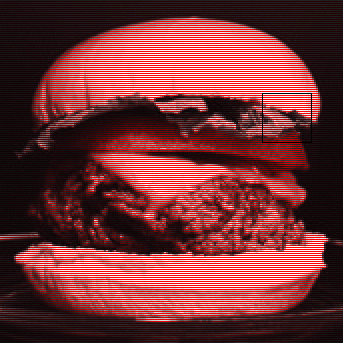
This picture of a hamburger is filtered through a red filter -- only the color red is "there" -- but we clearly perceive the green of the lettuce and the brown of the burger. The green in particular is very striking -- no green light is coming from your monitor, but there is green in the picture nevertheless.
The resonances with Goethe's theory are obvious. It is interesting that Land (CEO of the Polaroid Corporation!) was a scientist much in Goethe's mold, given to intense, open-ended exploratory experimentation. This point is made in an excellent Physics Today article available here, which I would like you to read.
I've only been able to find one "color constancy" slide on the internet:
This picture of a hamburger is filtered through a red filter -- only the color red is "there" -- but we clearly perceive the green of the lettuce and the brown of the burger. The green in particular is very striking -- no green light is coming from your monitor, but there is green in the picture nevertheless.
Sunday, November 23, 2008
Being like a child
I'm still relatively puzzled by "The Sandman," and I wonder what Hoffman's references to childhood mean. For instance, Clara is described as childlike and while Nathaniel is healed, he is also described as returning to the childlike state from which he had to depart when he encountered "the Sandman."
Perhaps Hoffman was encouraging a more innocent and less scientific view on nature, enjoying nature for what it is instead of trying to take it apart with spectacles. Olimpia was beautiful if you look at each of her physical qualities individually, but holistically, there was always something off about her (e.g. her eyes, her gait, etc). This story seems to me as a reversal of stereotypes. We usually poets as the more emotional beings, but Clara is much more practical than the learned Nathaniel. In the Goethe color theory article, he describes his curiosity as child-like when he picks up the prism and he was a poet in addition to being a scientist. What characteristic in being a child do these authors admire?
Perhaps Hoffman was encouraging a more innocent and less scientific view on nature, enjoying nature for what it is instead of trying to take it apart with spectacles. Olimpia was beautiful if you look at each of her physical qualities individually, but holistically, there was always something off about her (e.g. her eyes, her gait, etc). This story seems to me as a reversal of stereotypes. We usually poets as the more emotional beings, but Clara is much more practical than the learned Nathaniel. In the Goethe color theory article, he describes his curiosity as child-like when he picks up the prism and he was a poet in addition to being a scientist. What characteristic in being a child do these authors admire?
But Why Sandman?
I agree with Stephanie's understanding of the Sandman, however I think that Coppelius is meant to symbolize something else. It is strange that he reappears in the story as a barometer salesman. Overall, I am just very confused as to he wrote this allegory, and most of all, why he called it the Sandman.
I suppose Sandman could be a reference to the way that scientists can throw sands in your eyes and confuse or blind you as Nathaniel was blinded.
Sandman
I am on the same page with Mike. I am not quite sure how to read the short story "The Sandman" by E.T.A. Hoffman. I do, however, have a theory based on the context of German Romanticism in our discussions from class, especially in relation to the discussion of how Newton ruined the appreciation of the rainbow.
For me, in the story, Nathaniel's father and Coppelius represent the scientists like Newton, probing for the secrets of Nature. As Clara writes in her letter to Nathaniel, "I expect the two of them were simply conducting secret alchemical experiments, which could hardly please your mother, since a lot of money must have been squandered and moreover, as is said always to happen to such inquiries, your father became obsessed with the delusive longing for higher wisdom and was estranged from his family" (94).
Nathaniel represents the Romantic poets, who would prefer to live in the imaginary world of their childhoods, failing to come to grips with the reality of science in the world.
Clara is obviously the voice of reason in the story, trying to help Nathaniel to stay attached to reality.
Olimpia would represent the rainbow, the mirage of beauty with unknown origin. For Nathaniel (and the poets), this mirage is taken at face value. For the other men at the ball, they feel there is something strange about Olimpia (especially her lifeless eyes), as Siegmund sates "we felt that she was only pretending to be a living being" (111).
Nathaniel once again tries to combat this opinion by saying that "it is only to the poetic soul that a similarly organized soul reveals itself!" (111).
Thus, I believe if the story is read in this context, we can see the allegorical critique of the Romantic poets vs. the scientists such as Newton.
The Sandman?
I have to admit that I'm not sure I completely understand the meaning and context of the story "The Sandman". Is Nathanel's comical yet tragic experience with Olimpia supposed to be an indication of the importance of determining to what degree our senses can be deceived? In this case, the story would seem to emphasize our ability to approximate such a determination through the science of optics. I suppose that this is why philosophers such as Descartes must have been so interested in the science of optics. It makes sense that Descartes, who begins his Meditations by disregarding all of his a posteriori knowledge and doubts his senses, would want to determine precisely how and with what degree of accuracy these senses perceive the material world.
Friday, November 21, 2008
Wednesday, November 19, 2008
Newton apparently conquers all
Two things about the readings surprised me: in the "Ode on This Splendid Ornament" there is a great emphasis on the fact that Newton has conquered everything there is to know in nature, "Heaven has been conquered and its innermost secrets are revealed." This would not be that surprising except that the poem suggests that these laws that Newton has discovered are things that "that creator of all things, while he was setting the beginnings of the world, would not violate." This goes beyond your typical idea of conquering nature - this seems to infringe on the omnipotence of God. God is contained within nature and Newton has discovered all of this. Something else that I found surprising was the emphasis on simplicity that Thomson found in Newton's science and the beauty in that. This returns to the idea that the simple is beautiful and it describes the divine, but I thought that the point was that despite its simplicity, there was still a mystery about it. Thomson states "from Motion's simple laws/Could trace the secret hand of Providence."
Negative Capability
I find it interesting, maybe even a bit sad, that Keats thought that Newton ruined the poetry of a rainbow by reducing it to a prism. I wonder if this statement could be better understood when considered alongside his theory of Negative Capability, which he describes in his letters as "when a man is capable of being in uncertainties, mysteries, doubts, without any irritable reaching after fact and reason." It seems to me that Keats would find Newton guilty of "irritable reaching after fact" and destroying a beautiful mystery.
Consequences of Newtonian Mechanics
The things that so often vexed the minds of the ancient philosophers
And fruitlessly disturb the schools with noisy debate
We see right before our eyes, since mathematics drives away the clouds
Error and doubt no longer encumber us with mist;
For the Keenness of a sublime intelligence has made it possible for us to enter
The dwellings of the gods above and to climb the heights of heaven.
- Excerpt from Halley's ode to Newton
I think this excerpt presents some of the serious idealogical consequences of Newton's view that the Romantics (and I would wager many PLS students including myself) are afraid of, but is there good reason to be? I think this passage (and the entire poem) can be interpreted to say that mathematics has replaced philosophy and that we are able to know the mind of God through it. I think this would be hard to argue against, but what Im not convinced about is whether Halley sees no place for philosophy. Do you think that Halley believes that philosophy is only replaced when it comes to natural science, or does the Newtonian mechanistic approach to the world apply to all things?
Subscribe to:
Posts (Atom)
